Sunday, November 9, 2014

China The New Wine Frontier: a wine lover’s photographic journey.


The straight rows of vineyards can be seen in remote Beng village in Yunnan Province near the border with Tibet. This is just one of the vineyards visited in my China The New Wine Frontier book and presentations.

China is now the world's largest market for red wine, having increased more than 136% since 2008. In France, the second largest consumer of reds, it has declined by 18%. Small wonder that Chinese wineries are springing up like Oregon mushrooms to meet the tremendous demand in their own backyard.


Yet most people outside of the Land of the Dragon have no idea about the country’s booming wine industry, or that the country’s wine history actually dates back at least 9000 years. 

Marco Polo rated the wine in far west Xinjiang, China during his Silk Road journeys, even suggesting a wine mixture for mad dog bites.


With a cow-powered plow, these farmers are pulling up the peanuts grown between rows of Cabernet Sauvignon in a Tinjian Province vineyard.

Join Janis Miglavs for a photographer’s and adventurist’s visual journey through parts of China and an incredible wine scene seen by few outsiders.  Get a behind-the-scenes peek at the booming industry. See the architecture, the vineyards, the people and the wine. 
 
This is how Chinese drink wine. They call it ganbei.

Along the way learn secrets like how to survive drinking wine with local Chinese during the common practice of ganbei.


The general manager at Chateau Changyu Baron Balboa in Shihezi, Xinjiang, holds up a copy of my China The New Wine Frontier book opened to a page showing another Changyu winery, Chateau Changyu AFIP Global.


Since it is only available in China at this time, these presentations are a rare chance to buy China The New Wine Frontier book, the definitive work on Chinese wineries written and photographed by Miglavs.

Can guns, bows and arrows, and bowling sell wine?


Changyu, China's largest winery, built Chateau Changyu AFIP Global one hour out of Beijing to sell wine with Disney-like attractions. Not only did they build a photo-perfect European-style Chateau and Village, but they also included a shooting range, archery, bowling and an Olympic-size swimming pool.

All to sell wine.

After a few wine tastings, try out the Al Capone-style shooting range at Chateau Changyu AFIP Global, near Beijing, China.

Perhaps attempt the archery before the wine tastings as the arrows are real at Chateau Changyu AFIP Global, near Beijing, China.


When you tire of shooting at targets, try a little bowling at Chateau Changyu AFIP Global, near Beijing, China.

For those who would like to swim off their hangover, Chateau Changyu AFIP Global, near Beijing, China has an Olympic-sized swimming pool. The water temperature is just right.

Yes, they actually do make wine—something like a million bottles a year—at Chateau Changyu AFIP Global, near Beijing, China.

Chateau Changyu AFIP Global, near Beijing, China.


All images copyright ©Janis Miglavs 2014

Thursday, November 6, 2014

A head injury led me to Ningxia petroglyphs.


A concussion led me to find inspiration in Yinchuan, China. 

While photographing the dinning room at hand-crafted YuanShi winery in China's Ningxia Region, I fell. Somehow I tripped descending the stairs into the space. I skidded down. My head slammed against the stone wall.

Dazed, I stood up slowly. When I looked in a bathroom mirror to see my forehead bleeding, I knew not all was right. My whole body was afraid, sensing something was wrong. That night I knew I had a concussion.

The stone stairs where I fell are at the back of this YuanShi winery dinning room. Yinchuan, Ningxia Hui Autonomous Region, China. China wine.
Even though I'm Type A to the max, the next day I cancelled my appointment with a very important winery. A concussion would not allow me to be in the scorchingly bright Ningxia desert sun.

While working alone in my darkened hotel room, something pulled me out to visit the city building two blocks away. Inside, to my surprise, I found a museum. There displays of petrogylphs from the nearby Helan Shan—Helan Mountain—pulled me in to the darkened museum rooms. 

I studied every etching. Inspired. Five hours passed as if a moment in the dark museum caves. These 12,000-year-old rock art works gave me new ideas for the African First Stories (Myth) Project I've been working on for the past 15 years.  

The Sun God Engraving made on the Helan Mountain as displayed in the Yinchuan museum.
The Helan Mountain was the boundary between the nomadic pastoralists to the north and the sedentary farmers to the south. So the Helan Mountain was a meeting place between the two lifestyles, and celebrated by the practice of engraving art in the rocks.


My lesson: an adventure begins through an open door (or a concussion). Unless you leave room for serendipity, how can the divine enter in?

The building housing the display of Helan Mountain rock art.

What do you think is the subject of this rock art made at Helan Mountain? This display in Yinchuan, Ningxia Region, China.


Tuesday, November 4, 2014

Does your winery offer child care like this Chinese chateau?


Ever wish you had child care when going wine tasting.  

Your problems are solved Chateau Changyu AFIP Global. Only thing is, the place is in China. But it's only one hour out of Beijing. Check it out. Depending on your offspring, it might be worth the trip.


At Chateau Changyu AFIP Global you can leave your child (remember in China most people can only have one offspring) at this Day Care Center. The place is fully equipped with the latest in video entertainment, and an eggar staff. Scope out the ceiling decor.
The winery and visitor center at Disney-like Chateau Changyu AFIP Global. The Child Care Center is, of course, in the adjoining faux European village.
The Child Care Center is just to the right of the church in this village adjoining Chateau Changyu AFIP Global. Oh yes, just in case you have a few too many ganbeis (bottoms up in Chinese), there are 90 unique hotel rooms in the village.  


All images international copyright 2014 Janis Miglavs.

For a more comprehensive look at the China Wine industry see my recently released book China The New Wine Frontier written in both Chinese and English. (The book already won the "Best in the World" award from Gourmand.)

To order the book in China go to Amazon China. 

To order in the USA or internationally, contact the author/photographer at janis@jmiglavs.com.

Sunday, November 2, 2014

I planted a vineyard because of my pollution.


Farmers plowing between rows of Cabernet Sauvignon in a Tianjin Province vineyard, China.
About one-half of the world’s population lives on less than $2 per day, according to the World Summit on Sustainable Development.


Our people are very, very poor. Not enough
food; we struggle for survival. In those kind of
times, you really cannot think about how to do
something beautiful, you only think about how to
survive. So for a long time most Chinese people
struggled to survive. In 1980, I was very poor. I was very afraid.


Then when I became successful, making some money,
I can consider other things. I made a lot
of money here in Shanxi Province; I took a lot of
profit from this place, but we left lots of pollution.


Now, I really feel guilty.


I know that dirty pollution is not natural. Human
beings create the pollution. Even if we start doing
something now, we need a long time, a lot of effort
and a lot of money to re-clean the environment. 


Grace vineyard, Shanxi Province, China. China wine.

Today if I am rich, I can build a very beautiful village here, but if the window can not be opened, and we cannot be outside, we can’t enjoy it.

So I planted a vineyard to create beauty. 

Mr. Chan Chun, Industrialist, owner Grace Winery, Shanxi Province, China

Tuesday, October 21, 2014

Vineyard harvest China style: Yunnan Province near Tibet

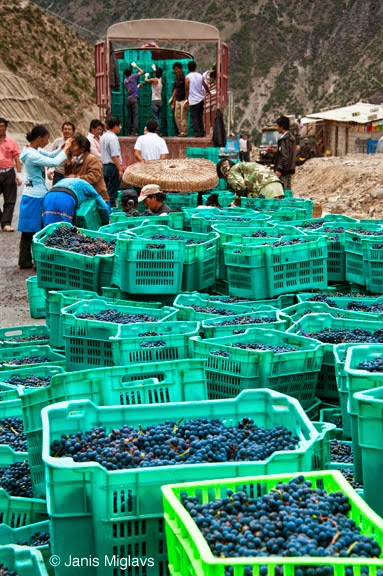
These scenes show the difficulty of harvesting grapes in the steep mountains of the far western tip of Yunnan Province near the border with Tibet, China. 

Originally, through special arrangements with the local government, Shangri-La winery, a division of Chinese conglomerate liquor maker VATS Group, was able to contract with local farmers to grow grapes on the tiny flat terraced plots of land. 

In spite of the rugged land and transportation difficulties, French spirits maker Moet Hennessy saw the positive climate and soil as great potential to grow quality wine grapes in this remote part of Yunnan.  

As a result, Moet Hennessy partnered with VATS Group's Shangri-La winery to form Moet Hennessy Shangri-La (Deqin) Winery Co. 

Wine has changed the economics in this mountainous region of Yunnan near the border with Tibet.  ShangriLa winery—now partnered with French-based Moet Hennessy to form Moet Hennessy Shangri-La (Deqin) Winery Co.—has made growing wine grapes profitable for farmers in villages like Beng (also called Bu) in the western part of Yunnan Province, China.   Beng is located on the silt-filled LanCang (also called Lantsang, Lansang and Mekong) River, in the HengDuan Mountain Range at the southern end of the Himalayas.
The Lancang snakes through the steep mountains past tiny villages with terraced farm plots on any piece of level land. Most of the village farmers now grow wine grapes as a cash crop here in Yunnan Province near the border with Tibet, China.

The vineyard terraces are steep in the western part of Yunnan Province near the Tibet border. These farmers contract with Moet Hennessy Shangri-La (Deqin) Winery Co. to provide wine grapes.
Moving harvested wine grapes to collection points for Moet Hennessy Shangri-La (Deqin) Winery is no easy task in this far western part of Yunnan Province. China wine.
Cabernet sauvignon and Merlot are the most popular varieties for the conservative thinking farmers in this far western part of Yunnan Province near the Tibetan border. China wine.

Once the Cabernet sauvignon grapes are loaded into the crates, they must be hauled up the steep hillside. The silted Lancang River roils below as it slices through the HengDuan Mountain Range at the southern end of the Himalayas. China wine.
Each crate loaded with Cabernet sauvignon grapes weighs about 20 kilos or about 44 pounds. China wine.


I can only imagine how tired a vineyard worker must get after hauling the harvested grapes up the steep hills all day long. These grapes are destined for Moet Hennessy Shangri-La (Deqin) Winery Co.  Yunnan Province, China wine.
Again, each crate loaded with Cabernet sauvignon grapes weighs about 20 kilos or about 44 pounds. This man is shorter and more slightly built than I am. China wine.
The only open level area Moet Hennessy Shangri-La (Deqin) Winery Co.has to collect harvested grapes is the middle of the road. Any other level plot in this far western  part of Yunnan Province must be devoted growing  crops, including wine grapes. There are 23 farming families delivering Cabernet sauvignon and Merlot grapes at the collection point. China wine.
The farmers use any available vehicle, including dump trucks to bring the harvest to the Moet Hennessy Shangri-La (Deqin) Winery collection area.  China wine.
The Shangri-La Winery general manager/vineyard manager must constantly teach the farmers what makes a quality grape that will bring the highest price. Yunnan Province, China.
While I saw these geese feed on insects, never once did they steel a ripe Cabernet sauvignon grape. Yunnan Province, China.


All images copyright ©Janis Miglavs 2014

Wednesday, October 8, 2014

Did we (modern man) or Neanderthals create the first religion (myths) trying to answer life's big questions?


Could this be what the dawn of man looked like? On my research trip this year, I took this photograph of a sunrise over the remote Mursi tribal village of Belle in Ethiopia's Omo region. During my stay in this village, I imagined that our modern man ancestors lived like this before a few walked out of Africa to populate our planet.

In 1856, in a cave in Germany's Neander Valley, Neanderthals were the first hominid ancestor to be discovered.

Comparison of the DNA of Neanderthals and Homo sapiens suggests that they diverged from a common ancestor, probably Homo heidelbergensis, who originated between 800,000 and 1,300,000 years ago. This evolutionary ancestor continued living in Africa, Europe and Western Asia until they vanished about 200,000 years ago.

Then, for some unexplained reason, between 350,000 and 400,000 years ago the African branch is thought to have started evolving towards modern humans and the Eurasian branch towards Neanderthals.

About 50,000 to 60,000 years ago modern man walked out of Africa to eventually populate our planet, according to Mitochondrial DNA. DNA also tells us that modern man and Neanderthals mixed.

In all of this evolutionary history, which of our ancestral storytellers tried to answer our mysterious big questions of life on earth?  Who created the first myth?

Was it Neanderthals or us modern Homo sapiens who first began asking about the creation of earth, and the creation of man? 

And what about archetypal dreams?