Friday, November 30, 2012

Never Let Them See You Sweat?

How many winemakers, creatives and yes, even photographers, who really care, expose the grit, determination and work it takes? I've just learned that "never let them see you sweat" is bad advice.

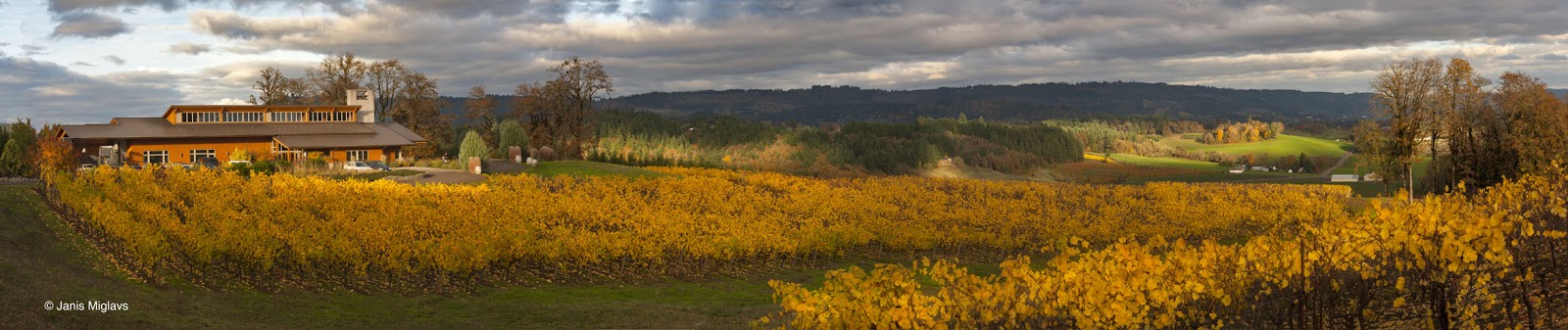
Fall Breaking Storm over Penner Ash Wine Cellars and the Willamette Valley.
After adjusting each of the 21 individual frames in the RAW File Converter, I stitched this panorama together. But it has rough edges and flat contrast, even after adjusting before stitching.
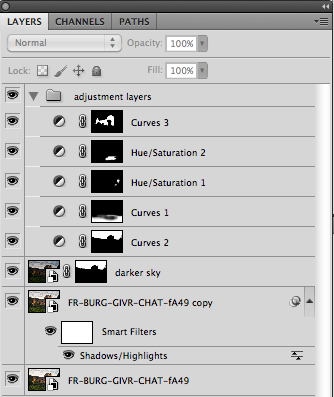
Check out the adjustment layers that created the more painterly look below. Each area is carefully selected and painted. This is the kind of work I did on canvas during my Masters of Art Degree.
I'm working to create an emotionally engaging image; one that brings joy and a sense of awe.
Isn't it the sweat that makes a piece of work individual?

Thursday, November 29, 2012

After a glass of Pinot, I apologized to Ansel Adams

Over Thanksgiving I struggled with perfection. 

Visiting friends and relatives wanted to see photographs from the September France trip my wife and I took. Groaning, I gave my all too often reply, "the photos are not optimized."

To me, that meant the photos are not ready for Ansel Adams-level show time.

Things haven't changed all that much since the film days of Ansel. A photograph from any digital camera is just raw material used to make the final image. In fact, I shoot in RAW format, which provides a pile of digital data that need to be interpreted. That interpretation is like Adams' idea of "the negative is the score, the print is the performance."

But creating a performance is a lot of work. After making a dozen or so big adjustments in the RAW file converter, I literally paint minute adjustments with Photoshop layers. Check out the screen capture of my layers palette for this simple photograph of the Gevrey Chambertin Chateau (recently bought by a Chinese businessman).

Photo as it came from RAW File Converter with about 6 basic adjustments.
Notice the addition of a sky layer with a stack of adjustment layers on top.
The final photograph has much more drama.
 The image becomes a painting, a visual performance.

But, if each France-trip image took 5 to 15 minutes to optimize, it would require at least 60 hours of painting to create a simple 100-image Holiday "slide show." (Add to that, first, I had to edit the 11,000 or so images I took during the three-week trip.)

I had to let go of perfection.

That's where wine came to the rescue.  After a glass of Oregon Pinot from White Rose Winery, I "optimized/painted" some key images—three hours—and used the JPGs straight out of the camera for the rest of the show—one hour. The show was done. Simple. No perfection.

Sorry, Ansel, it wasn't a stunning performance. But it was good enough.


Thursday, November 15, 2012

Early Oregon Wine made in a German's barn

In 1860 Oregon's wine production was something like 2,600 gallons, but we're not sure how much was fruit wine as opposed to the Vitis vinifera fruit kind.
 

Sometime in the 1880s, two German immigrant brothers—Edward and John Von Pessls— ventured north from California to plant Zinfandel, Riesling, and some kind of Sauvignon in southern Oregon. When one of their German immigrant buddies, Adam Doerner, visited the Von Pessl brothers some time the 1890s, Doerner thought, "hey, I could make wine here in southern Oregon also."

So the aspiring winemaker brought some Riesling and Sauvignon (we wish he would have kept better records as to the specific varietal) cuttings from the Beringer Brothers in Napa to the Umpqua region (that's in southern Oregon for all the Rush Limbaugh fans who didn't know). And where do early Oregon winemakers make their creations, in the barn. 

Doerner's barn winery still stands, but without the wine making equipment.

You can read more about Oregon Wine history in my book, Oregon The Taste of Wine, available in bookstores and at Amazon.

Sunday, November 11, 2012

Chinese buying France, French buying China

 
Chinese buy France:  A Chinese business man recently bought this chateau, the only one in Gevrey Chambertin appellation, which is home to some of the world’s most prestigious (and most expensive) red wines with 26 Premier Cru and 9 Grand Cru vineyards.

French buy China: French wine and spirits maker Moet Hennessy earlier this year partnered with Shangrila Winery (a subsidiary of Chinese liquor maker VATS Group) to develop vineyards and produce a super-premium red wine in this remote region of China's Yunnan province bordering Tibet.

Sunday, September 23, 2012

We discovered Chandonnay with the bones of Mary Magdalene

My wife Eddi and I decided to take the back roads from Gevrey-Chambertin to Chinon in the Loire Valley. We got lost winding through small villages, found huge chateaux not listed on any guide books and stumbled upon the bones of Mary Magdalene.
The hilltop Abby and community of Vézelay.
According to legend, near the end of the first millennium a monk brought bones of Mary Magdalene to Vézelay, France from Saint-Maximin-la-Sainte-Baume. In 1058, the Pope confirmed the genuineness of the relics, leading to an influx of pilgrims that has continued to this day.

Vézelay Abbey was also a major starting point for pilgrims on the Way of St. James to Santiago de Compostela, one of the most important of all medieval pilgrimage centers. 


In the 9th century the Benedictines were given land to build a monastery. The current Basilica was built in the 11th century. The town and the Basilica of St Magdelene are designated UNESCO World Heritage sites.

Bernard of Clairvaux preached the Second Crusade at Vézelay in 1146. In 1189, the Frankish and English factions of the Third Crusade met at Vézelay before officially departing for the Holy Land.

Today, Vézelay is a commune in the Yonne department in Burgundy.  Bourgogne Vézelay is the local wine appellation. Vineyards descend to the edge of the town and produce a range of mostly white wines, mainly on the Chardonnay, Melon de Bourgogne  and, of course, Pinot Noir.

Today the town is swarming with pilgrims—some would call them tourists—still seeking. Seeking what?  Well, I'm not exactly sure what they are seeking as they sit in the outdoor cafes sipping local Chardonnay. Surely this could not be the beginning of a new Crusade?


Friday, September 21, 2012

Reflection on history and my cousin's death

A few days after we arrived in France, we get a i-Phone call at 2:34 in the morning. The caller ID said it was my cousin John in Napa. He only emails. He never calls. So I answered even though I knew it would cost me $19.95 per minute.  Cousin Dave answered. Dave's news: his brother, my cousin, had just died. Didn't know the cause. Cousin John was 58; I'm 64. He's dead. I'm in France.

His death colored my thoughts through the rest of France. When visiting the large chateaus, I thought about how most of us live simple lives which will be forgotten in a generation or two. Most of us will never become famous. Even though we live the best we can, history will quickly erase us.

Somehow I found myself photographing lots of cemeteries for the rest of the trip. Was that my meditation on history and death?
Gevrey Chambertin village cemetery seen across Premier Crus Petits Cazetiers vineyard. I like the idea that there has been a vineyard and village here for at least a 1000 years, probably longer.