Showing posts with label Oregon. Show all posts

Sunday, November 9, 2014

Why Native Americans today cannot look at Oregon's Crater Lake.


Sunset light falls on Crater Lake in southern Oregon.
The Klamath Indians have this story about Oregon's Crater Lake:

A band of Indians were returning from a hunting trip and went up a mountain. At the top of the mountain they looked into its crater and saw a most beautiful blue lake -- bluer than the skies above it. They were awed by the intensity of the blue depths and by the smoking island in the lake. They were sure it was the home of Llaos, the Great Spirit.

Feeling that they had invaded forbidden ground, they quickly retreated down the slope and made camp for the night at a fitting distance away.

But one of the Indian braves could not forget the beautiful sight. He could not resist going back to stand on the rim and gaze at it. When he came away he felt much stronger. He went again and came away stronger and more powerful. After a third visit he grew daring and decided to go down the steep side of the crater. He bathed in the beautiful blue waters. After this he was the strongest and most skillful warrior of the tribe.

Imagine the Native American diving into Crater Lake and becoming a better hunter. Then one Indian ruined the lake's magic powers.
Other Indians wanted to do as he had done. So they also looked at the lake and bathed in its waters and each one came away more powerful than he had been before. They were better hunters, faster runners, more sure of their skills.

But one day, for some unknown reason, one Indian brave, when he was bathing in the lake, killed one of the creatures that lived in the water. Suddenly hundreds of the lake creatures, or Llaos, came from the water, rushed after the warrior and killed him. This ended the spell for all Indians, and they now knew that they could no longer go to the lake.

The fathers told their sons, and those sons told their sons that "death will come to any Indian who even dares to gaze upon the blue waters of Llaos Mountain."
This story taken from the Oregon Blue Book.


Oregon's Crater Lake under the magic spell of winter.


Friday, November 30, 2012

Never Let Them See You Sweat?

How many winemakers, creatives and yes, even photographers, who really care, expose the grit, determination and work it takes? I've just learned that "never let them see you sweat" is bad advice.

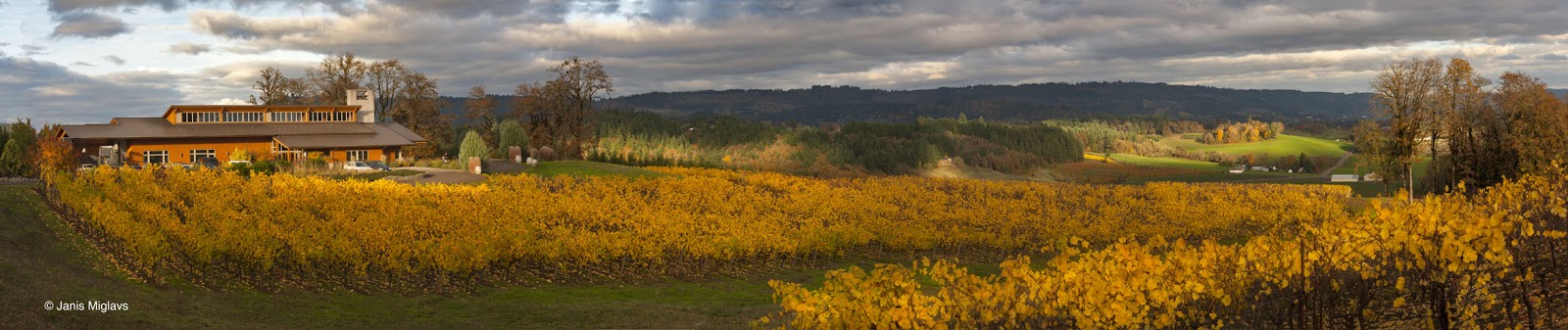
Fall Breaking Storm over Penner Ash Wine Cellars and the Willamette Valley.
After adjusting each of the 21 individual frames in the RAW File Converter, I stitched this panorama together. But it has rough edges and flat contrast, even after adjusting before stitching.
Check out the adjustment layers that created the more painterly look below. Each area is carefully selected and painted. This is the kind of work I did on canvas during my Masters of Art Degree.
I'm working to create an emotionally engaging image; one that brings joy and a sense of awe.
Isn't it the sweat that makes a piece of work individual?

Friday, August 10, 2012

Is it always necessary to take a picture?

This morning just after my first cup of decaf, I saw a Great Blue Heron sitting on our deck railing. Yes, on our very own deck, 5 meters (15 feet) from me. At first I just stared in slack jaw wonder.

Then, ding ding, I remembered: "Dummy, you're a pro photographer, you should take a picture." But no camera, not even an iPhone in sight. Would he wait for me to get my Nikon D800 from my office? 

Fortunately, the bird sensed that I was a true pro and patently stood his ground on the railing. Fortunately also, I had to photograph through our screen door to get that professional soft look with those special-effects lines. (Compliments to Nikon, I had no focus problems through the screen door filter in the foreground.)

Sometimes I wonder if it might be better just to watch and enjoy the moment instead of running to get a camera. 

What about you? Do you always take photos during those full-of-wonder moments?

Monday, August 6, 2012

The influence of cattle & weather on Oregon wine

Locals say that if you don't like the weather now in Oregon wine country, wait a minute or two. This time lapse shows 30 minutes of Oregon Spring-time weather in Briggs Hill Valley seen from Sweet Cheeks Winery vineyard just south of Eugene in the Willamette Valley.

Besides the clouds and sun breaks, watch the ant-sized cattle on the center left side of the big barn. (Cattle are part of the Oregon terroir, providing valuable aromas to make a more complex wine.)


Monday, July 30, 2012

Monks divide Burgundy at Oregon's International Pinot Noir Celebration

If you you had a magnifying glass for the fine print identifying the wines in the photograph, you would read that all the wines we sampled at the "Study Abroad in Burgundy" session at Oregon's International Pinot Noir Celebration in McMinnville are either Premier or Grand Cru wines. That means they represent the best Burgundy has to offer. It was a shame to spit, but it was 9:00 a.m..
At my very first session at the International Pinot Noir Celebration, I learned it was the monks who divided Burgundy into wine growing regions hundreds of years ago. The IPNC session was "Study Abroad in Burgundy".

Those Cistercian Monks first appeared on the European scene nearly a 1000 years ago.  They built their first abbey at Cîteaux (Latin Cistercium, hence "Cistercian") near Nuits-Saint-Georges.  It just happeed that several of the wines we tasted in the IPNC Burgundy session had roots in the region. It felt like I was tasting history.

As they grew grapes and made wine, those monks kept great records, according to moderator Allen Meadows, who spends 4 months a year in Burgundy when he visits more than 300 domaines and publishes Burghound.com—an e-newsletter specializing in Burgundy. Those monks started to notice that the wine from one parcel tasted different from the next, sometimes from adjacent plots. 

Fortunately, they planted lots of Pinot noir, the most terroir transparent of grapes, says Meadows. He claims the monks were tasting differences in terroir, in geography, in soil, in temperature.


The monks attributed the taste differences to God. For those pious monks, Pinot noir was only the messenger, not the message.


Regardless, those monks prospected for terroir. They planted vines everywhere but only kept those that were the most interesting. And they took meticulous notes, keeping volumes of hand-written records. So now Burgundy has hundreds of years of history of knowing what will grow best where.

Thus today, Burgundy is divided into many different appellations, sometimes covering only a single vineyard. In fact, Meadows said there were some 1600 different "climats"—a term unique to Burgundy which designates each plot or group of plots of vines which have been known under the same name for several centuries.


In the end, Meadows and the 5 Burgundian panelist—Bertrand Ambroise from Maison Ambroise, Cyril Audoin of Domaine Charles Audoin, Philippe and Vincent Lécheneaut of Domaine Lécheneaut and Jacques Lardière of Maison Louis Jadot—seemed to agree with the historic monks: Pinot noir was the messenger of Burgundy terroir.

Thank you monks. Thank you God.


Thank you Anne Amie Winery, one sunny IPNC host

This weekend at the International Pinot Noir Celebration (IPNC) conference at Linfield College in McMinnville, Oregon, highlight sessions were held at Willamette Valley wineries which were undisclosed to us mere attendees until we boarded the bus to the destination. I lucked out. Our bus—tour guided by Texan-turned-Oregon-winemaker Rollin Soles—ended at Anne Amie Winery. What an Oregon treat.
With glass in hand, vineyard manager Jason Tosch gave us a tour of the estate vineyard while we sampled the results.
Some found the production equipment especially relaxing.
Then a honest peek at what it takes to make great wine.
Can life get any better than lunch with a panoramic view of the Willamette Valley?


Thank you to all the wonderful people at Anne Amie Winery for providing such a memorable Oregon experience.