Showing posts with label China the new wine frontier. Show all posts

Saturday, April 22, 2017

Trump's wine choices not on my World's Most Incredible Vineyards List


A couple of weeks ago Trump hosted China’s president, Xi Jinping, for talks in the US. I wonder how the decision was made to serve the two California wines at dinner?

Imagine Xi's diplomatic surprise if our President had chosen a world-class Chinese wine from a Yunnan Province vineyard. Two Yunnan vineyards are pictured below. Know and surprise your enemy? 


Trump could have chosen a world class wine from President Xi's own back yard. Chinese Shangrila Winery joint ventured with Moet Henessey to make wine from vineyards in the mountains of Yunnan Province.  Beng (some call it Bu) village on LanCang (also called Lantsang, Lansang and Mekong) River is one of my favorite incredible vineyards. This is in the Heng Duan (Hengduan) Mountain Range, Yunnan Province, China.

Cabernet Sauvignon vineyard in front of historic Catholic Church, first built in 1867 and rebuilt in 1909, in Cizhong village on LanCang (also called Lantsang, Lansang and Mekong) River, Yunnan Province, China.

Trump could have chosen a French wine, such as a Romanée-Conti from the famous vineyard pictured below. To most Chinese, France is wine. Know and surprise your enemy.
 
Signature cross in front of world-famous Romanée-Conti vineyard above Vosne-Romanée village, Burgundy province, France.

Clouds create passing shadows over Romanée-Conti vineyard (to left of the paved road) in front of Vosne-Romanée village, Burgundy, France.

Neither of Trump's California selections are exceptionally good pairings with the hamburger he promised during the  presidential campaign to serve Xi . Apparently, the McDonalds-meal promise was not kept.

While Trump has repeatedly said that he is a teetotaler himself, he served his dinner guests a 2014 Chalk Hill Chardonnay from the Sonoma Coast and a 2014 Girard Cabernet Sauvignon from Yountville in Napa Valley, according Decanter news.


Here are vineyards providing other choices Trump could have made from my World's Most Incredible Vineyards List.


Spring mustard flowers in highly-rated Screaming Eagle Vineyard on Silverado Trail Road. 
USA, California, Napa Valley.

Vineyard view from Artesa Winery on Henry Road, in the Carneros wine area of Napa Valley, California.

And don't forget Oregon. Check out my book Oregon The Taste of Wine to get insights into why Trump could have chosen a wine from Oregon wine country.

Cabernet Sauvignon grapes with bronze-colored leaf on knarly old vine in Valley View Winery and Vineyard in the Applegate Valley, Oregon.

My book China The New Wine Frontier offers a cellar door insight into President Xi and the Chinese culture, but it is only available in China. I'm now working on a version for the rest of the world.


Monday, May 2, 2016

How an American can get wine from Ningxia China


Recently I received an email asking how someone in the USA can get wine from Ningxia province of China. Several times I've also needed to get any Chinese wine as samples for speaking events.

Getting the stuff in the USA, let alone from a specific province, is difficult and often the quality is disappointing. 

But if you have an unquenchable thirst for Chinese wine, try these:

1) Sift through this site, but know that many of the wines might not be available: http://www.snooth.com/wines/china/

2) Dragon’s Hollow grows grapes in Ningxia only for export to USA. Founder David Henderson is a great guy with extensive trading experience in China. Try contacting him directly: http://www.chinafinewines.com/default.aspx


3) If you happen to have a friend in the UK who is coming to the USA, have them go into Berry Bros & Rudd at their St James’ to scout for Chinese wine. Or they can try the BB&R web site: http://www.bbr.com/region-14-china

4) While I haven't checked lately, the Great Wall Shopping Center in Kent, Washington, did offer a bottle of Changyu wine for $18. (Warning, even though Changyu is China's largest winery, the wine should be experienced in the spirit of adventure without great wall-sized expectations.)

If you order or get Chinese wine in the USA, please let me know the outcome.


Please respect that all images are copyrighted 
© Janis Miglavs 2015
janis@jmiglavs.com

Saturday, April 23, 2016

Did my karaoke or President Xi force sale of China's Chateau Junding for 15 cents?


China's food service conglomerate, COFCO, is selling their 55% share of Chateau Junding for 1 yuan (that's about 15 cents). 

Chateau Junding in Shandong Province.

This news evoked a flood of memories, some painful.  Chateau Junding was the very first winery I visited on my inaugural China wine trip in 2009.
Chateau Junding, with its restaruants, tasting rooms, gift and wine shops, golf club, golf course and underground cellars all sit on 400 hectares (almost 1000 acres).

Since I had never done any kind of business or journalism in China before, I didn't really know the protocol.
Night view of stone bridge leading to Chateau Junding winery, near Penglai, Shandong Province, China.
It took months of email introductions to finally get a dinner appointment with some Junding bureaucrat when I arrived to Beijing. 

But the guy must have liked the way I used chop sticks because a couple of days later I was flying to Jinan, the capital of Shandong Province, to meet with head marketing director, Ms. Lin. In fact, she actually met me at the airport for the hour drive to Junding.


Chateau Junding winery, with Phoenix Lake in the background, seen from nearly 1000 acre estate vineyard, near Penglai, Shandong Province, China.

The place was huge. They gave me a golf cart to get around on the nearly 1000-acre Junding estate for 3 days of photography.
One of the roads to Junding's Golf Club.
Workers tend the expansive Junding golf course so clients can catch a perfect 18 holes before dinner and wine at Chateau Junding seen on the other side of Phoenix Lake.

Assistant winemaker taking sample in barrel cellar at Chateau Junding winery, near Penglai, Shandong Province, China.
This bottle  of wine, created for the opening of the Chateau Junding winery, lists for RMB27998 (US$4442). Asia, China, Shandong province.
  

The whole Chateau Junding concept was to attract luxury consumers and government officials to an opulent lifestyle, like the Cab Sauvignon retailing for a cool US$ 4,442 a bottle.The idea was that it should be given as an expensive business gift as everyone knew the price.

Dining in one of the many restaurants and private rooms at Junding winery near Penglai in the Shandong Province, China. This photograph was taken of an important regional wine director in 2009, at the height of spending on government officials.

One of the days during my visit, Junding hosted a handful of Chinese government officials and the head of the regional Winery Association. After a dinner enjoyed with some Oregon wine I had stuffed into my suitcase, we headed down to a huge entertainment center.  

Now these guys were hot on karaoke. And they just assumed I, being from the United States, knew all the English-language songs ever written. And worse, they thought I could sing. 

It was terrible. I couldn't even remember all the words to "Hey, Jude." Luckily, the marketing director knew the song and had a great voice.

Fortunately for me, the Chinese officials drank a lot of wine, a really lot of wine. We're talking bottles of wine each. At the end of the karaoke evening, I carried out some really important government wine people out to their black Buicks.

I got lost trying to find my way around all of the restaurants, private rooms and entertainment centers.


But current President Xi's straight-laced program of anti-corruption and austerity policies put screeching brakes to the karaoke and spending lots of yuan at the winery resort, especially for government officials. 

Now the expansive estate is visited more by busloads of curious Chinese tourists than actual clients.

Evening view of Chateau Junding winery, near Penglai, Shandong Province, China.


So the place is for sale.

Oh yes, there is one minor caveat to the Chateau Junding sale price: besides paying the 15 cents, the buyer must also pick up the tab for the debt on the property. For that bring an extra 392m yuan (a bit more than US$ 60,000,000) and controlling interest of the place is yours.


Farm vehicle in front of vineyard and buildings of Chateau Junding winery near Penglai in the Shandong Province, China.


They do have a great karaoke machine. So I keep wondering if it was really my bad karaoke or President Xi's policies forcing COFCO to sell Chateau Junding?

As government policies and winery sales swirl, workers still tend the vineyard.


Please respect that all images are copyrighted 
© Janis Miglavs 2015
janis@jmiglavs.com


Wednesday, December 16, 2015

Why build a $100 million Disneyland-like wine oasis in the Chinese desert?


In China's far-west Xinjiang desert, not far from where Marco Polo traveled the Silk Road, sits a new wine oasis. It's called Chateau Baron Balboa. Changyu, China's largest winery, built it to provide the visitor a Disneyland-like "wine experience" in the dusty desert.


The road to Changyu's wine oasis, Chateau Baron Balboa, in the desert of Xinjiang Uygur Autonomous Region, China.
Changyu, China's largest winery, built Chateau Baron Balboa wine oasis to attract visitors. The marketing idea is to provide a Disney-like "wine experience," then convert them into wine consumers.

Professional wedding photographers are lined up two or three deep at key locations to take snaps of newly weds. Changyu's Chateau Baron Balboa, in the desert of Xinjiang Uygur Autonomous Region, China.
Changyu Chateau Baron Balboa near Shihezi, Xinjiang, is designed to be a Disney-like tourist destination under the shell of a European-style chateau. China's largest winery, Changyu,wants the visitor to experience wine culture at all of its four Sino-based chateaux, and then, of course, buy more wine. In the near future, Changyu plans to build at least two more chateaux, plus a whole wine city, which by itself will reportedly cost about 6 billion yuan (about US $1billion), near its headquarters in Yantai, Shandong Province.

Changyu's Chateau Baron Balboa, in the desert of Xinjiang Uygur Autonomous Region, China.

Changyu's Chateau Baron Balboa, in the desert of Xinjiang Uygur Autonomous Region, China.

Workers trim Cabernet sauvignon vines by hand at Changyu's Chateau Baron Balboa, in the desert of Xinjiang Uygur Autonomous Region, China.

General Manager and Winemaker of Changyu Chateau Baron Balboa in Xinjiang, Hao Dongshu, holds a copy of my book China the New Wine Frontier to the chapter on sister winery, Chateau Changyu AFIP Global near Beijing. These are two of Changyu's current chateaux.

Yes, they do actually make wine at Changyu Chateau Baron Balboa, Xinjiang Uygur Autonomous Region, China.

A specially-designed-for-the-tourist-walkway totally encased in glass and Greek-style columns, showcases the Chinese made bottling line on the left and a cellar housing French-oak barrels on the right.  Xinjiang Uygur Autonomous Region, China.

To the Chinese, Europe, especially France, means good wine. So Changyu hopes to set a "wine experience" mood for the visitors.
Somehow, even this bronze rock star musician in the Chateau garden area must be part of the "wine experience" Changyu offers visitors.

When I found this dog-headed photographer statue, I knew that this had to be the right place to take a great photograph.


All images © Janis Miglavs 2015
janis@jmiglavs.com

Chinese government dusts off an ancient master plan: use soldiers to work the vineyards.


How would you have fed the 10,000  soldiers needed to man the 13,000 miles of Great Wall 2000 years ago? And how would you feed all of your soldiers out there conquering new territories?

Frustrated by the futility of long supply lines, the Chinese emperors and generals developed the idea of soldier farmers. These guys would be warriors and at the same time know how to grow their own food.

Supply line problem solved.

Now it looks as if the Chinese government looked to history to help solve a current problem.

Quite by accident, on my visit to the Citic Guoan winery vineyards way out west in Xinjiang, I found that the Chinese government has resurrected the 2000-year-old eat and conquer concept.


A tractor pulling a wagon passes some housing built for Han soldier-farmers near Fukang, in the Xinjiang Uygur Autonomous Region, northern Xinjiang Province, People's Republic of China.

These workers prune Chardonnay vines, preparing them so they can be buried during the frigid vine-killing winter on agricultural land managed by the 222 Unit of China's Xinjiang Production and Construction Corps, known as XPCC, the PCC or Bingtuan for short. a unique economic and semi-military governmental organization in the Xinjiang Uyghur Autonomous Region). The grapes are used by Citic Guoan Winery.

To deal with the restless Uyghur population, some of who blow up buildings and people, the government has sent an army of Han (the dominant ethnic population in China) out west.

During the summer months these imported men and their families work the fields, including the vineyards. When the cold months come, they train as soldiers. For the government, this instantly solves two problems: provide workers for the labor shortage out in the west and have a standing army ready to battle insurgents.


A worker prunes Chardonnay vines, preparing them so they can be buried during the frigid vine-killing winter on agricultural land managed by the 222 Unit of China's Xinjiang Production and Construction Corps, known as XPCC, the PCC or Bingtuan for short, a unique economic and semi-military governmental organization in the Xinjiang Uyghur Autonomous Region). The grapes are used by Citic Guoan Winery.


Entire towns are built for these Han soldier-farmers.


This castle-like building houses the kindergarten classrooms on a "bingtuan," military-run farm. China, Xinjiang Province, Xinjiang Uyghur Autonomous Region, Changji Hui Autonomous Prefecture.

Housing for the Han Chinese settlers on a "bingtuan," military-run farm near Fukang, Changji Hui Autonomous Prefecture, Xinjiang Uygur Autonomous Region, northern Xinjiang Province, China.

This Han worker prunes Chardonnay vines so that they can be buried for the freezing winter. While the vines are dormant, he will train as a soldier. Xinjiang Uygur Autonomous Region, northern Xinjiang Province, China.

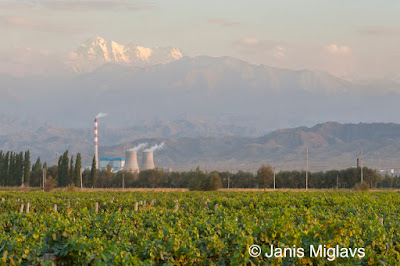
Citic Guoan Winery gets Cabernet Sauvignon grapes from this vineyard sitting in front of a nuclear power plant and Bogda Peak in the Tian Shan Mountain range.
Xinjiang Uygur Autonomous Region, China.

Please respect that all images are copyrighted 
© Janis Miglavs 2015
janis@jmiglavs.com

Monday, November 23, 2015

Photographic visit to 12 wineries in China's hottest wine region


Get a sense for the impressive growth and intensity of investment over the past several years by visually visiting 12 of the more than estimated 50 wineries that have sprouted in the Ningxia desert. 

This will give you an insight into why China is booming.


Moët Hennessy's Domaine Chandon Ningxia
Moët Hennessy broke ground on April 2012 on Domaine Chandon Ningxia of this modern winery to produce sparkling for the Chinese market. Yinchuan, Ningxia Hui Autonomous Region, China.
Pinot noir in the desert anyone?
Formal tasting and dinning room at Domaine Chandon Ningxia. You can see the stainless steel tanks through the glass windows. Yinchuan, Ningxia Hui Autonomous Region, Chin


Silver Heights Winery, Ningxia

French-trained winemaker, Emma Gao and her father working pump-over hoses at family-owned Silver Heights winery, Yinchuan, Ningxia Wine Country, China.
Tired of depending on local farmers, Emma Gao and her family of Silver Heights Winery have purchased land parcels near Helan Mountain to plant their own vineyards. Did you happen to see Chairman Mao staring skyward from the mountain ridge in the background? Ningxia Hui Autonomous Region, China.
Masked against the dust, a female worker harvests Cabernet Sauvignon grapes destined for Silver Heights winery from a farmer near Yinchuan, Ningxia Wine Country, China.


COFCO's Great Wall Winery, Ningxia
COFCO's Great Wall Winery at the base of Helan Mountain.  State owned, COFCO  is China's largest food processing, manufacturer and trader.  Ningxia Hui Autonomous Region, China.


Pernod Richard's Domaine Helan Mountain, Ningxia
From the informal front entrance, Pernod Richard's Helan Mountain winery looks like a Soviet-era factory. Inside is a different story. Ningxia Province, China.
Pinot noir grapes on sorting line at Pernot Ricard's Domaine Helan Mountain winery, Ningxia Wine Corridor, China.
The scale is impressive. Stainless steel fermenting tanks at Helan Mountain winery, Ningxia Wine Region, China.
Nothing goes to waste in China. That's about a quarter mile of grape seeds from Helan Mountain winery this Worker spreads to dry for sale to the cosmetics and aromatherapy industries. Ningxia Wine Region, China.


Ningxia Chateau Lanny Winery and Resort

Local government-owned estate chateau Lanny (sometimes seen incorrectly spelled Lanyi) Winery and Resort near Yinchuan, in Ningxia Hui Autonomous Region, China.
Chateau Lanny uses a trellising system to support vines that looks more like those used for table grapes. If you look carefully, you might see Chairman Mao's profile in Helan Mountain. Ningxia Wine Corridor, China.
If you get tired of tasting wine or have a few too many "ganbeis" (the Chinese bottoms up way of drinking), you can sleep the night away in one of Chateau Lanny's guest rooms. Ningxia Wine Corridor, China.


  Changyu Moser XV, Ningxia
Changyu is China's largest winery. So naturally they have a huge presence in Ningxia. This is the nightly light show at Chateau Changyu Moser XV just at the outskirts of Yinchuan, Ningxia Hui Autonomous Region, China.
Just to make sure that visitors get the idea that they are at a winery, Chateau Changyu Moser XV placed this huge grape sculpture as a not-so-subtle hint.  Yinchuan, Ningxia Wine Region, China.
No winery should be without Medieval-era armored guards. Obviously, no shoplifting here.  Regardless, Changyu provides a Disney-like experience at Chateau Changyu Moser XV in Yinchuan, Ningxia Wine Corridor, China.
Changyu believes in educating visitors at their newer chateaux. Chateau Changyu Moser XV is no exception.  Ningxia Hui Autonomous Region, China.
An interactive video game in the visitor's center is very popular among the younger visitors. On another note, the Chinese seem to enjoy photographing foreigners and I happened to be the only one available that day at the chateau. Chateau Changyu Moser XV in Yinchuan, Ningxia wine region, China.
And what would a chateau be without vineyards.  Chateau Changyu Moser XV in Yinchuan, Ningxia Wine Region, China.


Dragon's Hollow Vineyards, Ningxia
David Henderson, founder of Dragon's Hollow Vineyards, started a number of business and schools before in 1988 creating Montrose Food and Wine to become obtain the first direct license to import wines into China. Then he started Dragon's Hollow with the novel idea of exporting all of his wine. All of the vines he harvests fruit are part of the Helan Shan (Helan Mountain) estate. Ningxia Wine Country, China.
Henderson currently uses the Pernod Richard's Helan Mountain facility, to make his wine. Here Ms Zhou, in light tan coat and head winemaker at Helan Mountain winery, checks one of Dragon's Hollow's rented tanks.  Ningxia Province, China, Asia


Imperial Horse, Ningxia
While Dynasty has been making Imperial Horse wine in Ningxia for many years, every time I go by the facility, there doesn't seem to be much activity. Perhaps I visited only on some surprise national holiday. Imperial Horse winery, Ningxia, China


HeLan Qing Xue Winery, Jai Bei Lan wine, Ningxia
This is where the Ningxia buzz started. At the 2011 Decanter World Wine Awards, their Jia Bei Lan (also spelled JiaBeiLan) Grand Reserve 2009 was awarded the International Trophy for Red Bordeaux Varietals over £10. There was lots of speculation about how a Chinese winery beat some of the world's best Bordeaux-style wines – including those from the Médoc and St-Emilion.  HeLan QingXue Vineyard and Winery, Yinchuan, Ningxia Wine Region, China.

Founded in 2005, Helan Qingxue Vineyard and Winery was the first demonstration vineyard in Ningxia. The idea was to be a government-based, winery-funded association and role model for new owners considering a wine operation in Ningxia. No longer a winery association, its founders now run the estate as viticulturist, winemaker and manager. Controversy swirled who was the actual winery of the 2009 Decanter awarded wine as Li Demei, a professor at Beijing Agriculture College was a consultant there at the time.  HeLan QingXue Vineyard and Winery. Yinchuan, Ningxia Wine Region, China.
As at many Chinese wineries, labels are hand glued onto the bottles at HeLan QingXue Vineyard and Winery. Yinchuan, Ningxia Wine Region, China.


Ningxia XiXiaKing Chateau Yuquan Winery 
Chinese style Yuquan International Wine Chateau of Xixia King fronts one of their vineyards. Yinchuan, Ningxia Hui Autonomous Region, China.
After seeing dozens of Chinese wineries in all sorts of architectural styles, I found it refreshing to see more traditional Chinese design used at Chateau Yuquan. Ningxia Wine Region, China.
The grandious lobby of Chateau Yuquan.
Opened in 2014, the lobby of Chateau Yuquan's hotel gives a hint of the rest of the interior. Besides guest rooms, there are all sorts of game rooms. The hotel complex is next to the Chateau.  Chateau Yuquan, Yinchuan,  Ningxia Hui Autonomous Region, China.
In the display area, traditions are integrated. Here ancient Chinese businessmen drink Chateau Yuquan wine in tea cups. Chateau Yuquan, Ningxia Wine Region, China.
Chateau Yuquan, Ningxia Wine Region, China.


Ningxia Daylong Winery
With it's fairytale castle-like architecture, Ningxia Daylong Winery, run by the Thailand-based Daysun Investment group, has the Ningxia Chateau Lanny Winery and Resort's young vineyard in the front yard and Helan Mountain as a background. Ningxia Hui Autonomous Region, China.


Ningxia XiXia King

XiXia King has great plans to build an entire wine complex on the property. Some of those plans have been built—Chateau Yuquan and the nearby hotel. According to the company president, future plans call for Huang Yangtan Xixia Culture Grape Town and Nuan Quan Holiday Grape Town.
Established in 1982, Xixia King is the oldest and probably still the largest winery in Ningxia, with over 130,000 mu (that's more than 21,000 acres) of vineyards. (Mu is the Chinese measure of land area with approximately 6 mu to an acre.) That's nearly one-half the total vineyard acreage of Napa Valley AVA. Ningxia Wine Region, China.
Production area XiXia King winery.
Bottling line XiXia King winery.


Chateau Yuanshi, Ningxia
This is one of my favorite Chinese wineries as it is built from natural stone taken from the site, built in a local architectural style and crafted by local masons.  Here sunrise touches the natural stone buildings of Chateau Yuanshi Winery near Yinchuan city in Ningxia Wine Region, China.
All of the buildings are made of natural stone found on the property. The owner grew up on the site. Chateau Yuanshi Winery near Yinchuan city in Ningxia Wine Region, China.
This stone mason told me that it would take him two days to carve this single stone for a new building at Chateau Yuanshi Winery near Yinchuan city in the Ningxia Hui Province wine region next to Helan Mountain.
Worker topping off French oak barrels at Chateau Yuanshi Winery near
Yinchuan, in Ningxia Hui Autonomous Region, China.
One of the tasting rooms.
Chateau Yuanshi (Yuan Shi) Winery designed in local Chinese architecture style and build from local stone near Yinchuan, in Ningxia Hui Autonomous Region, China.


All photographs and text © 2015 Janis Miglavs
www.jmiglavs.com
janis@jmiglavs.com