
Bob McRitchie, Ph.D., recalls the early years of the 70s and 80s:
"While I was winemaker at Sokol Blosser, the Oregon Department of Agriculure had this dairy mentality, the idea of cleanliness being next to godliness. We had one inspector who vowed he would get barrels out of the cellar because you can't pour wine in wood. It's just not clean."
I wonder if the inspector had ever tried French wine?
Monday, November 24, 2008


Sunday, November 23, 2008
Exactly how did Oregon Wine become World Class?
 Jim Maresh still remembers the exact day in 1968, when Dick Erath came up the driveway and convinced him to pull out some of his orchard to plant Pinot noir.
Jim Maresh then recalls a conversation with Dick at a celebration for Erath's twenty-fifth crush:
There were about two hundred people and we're drinking this great Oregon Pinot. Dick and I were sitting under a tree, and he said to me, "Jim, did you ever think it would be this big?"
I said, "No."
He said, "Back in 1970, we sure didn't know what we were doing."
I said, "You told me right in front of your crusher you knew what you were doing; now twenty-five years later, after I had pulled out all my orchard, you tell me different?"
And he said, "I didn't have a clue."
So, exactly how did Oregon Wine become world class?
Thursday, November 20, 2008
Will Oregon Wine Country become a Theme Park in the Future?
 For the Oregon: The Taste of Wine book, I asked winemakers, winery owners and vineyard managers what they thought the Oregon Wine Industry would look like 50 years from now.
Ed King from King Estate Winery replied:
"We see Portland growing rapidly. It's under great pressure to accommodate a huge influx of people who recognize it as a wonderful city. It's maybe the top American city today, at least in the top three or five, in terms of livability and quality of life. While we have a significant number of land use restrictions, if we were to add a half a million or a million people to the current Portland urban growth boundary–I don't know that anything is sufficient to withstand the influx of that many people. Many of those people are going to explore every nook and cranny to find a place to live out of the city.
"The wine industry is going to have to fight all along the way. Economics won't protect the vineyards. We've seen valuable vineyard land in Napa that is still more valuable for houses. The same is gong to be true around Portland, if we let economics run the game. You could see the vineyards of McMinnville, Dundee, Carlton, Eola Hills all overwhelmed by the demand for housing.
"You could end up with this kind of vineyard in a terrarium, with a little glass dome over the cute little winemaker's old pickup truck and his dog. You drive out and pay your fee to see them. It's like a visit to the zoo."

What do you see in the future?
Winemaker Doug Tunnell with his red
pick up at Brickhouse Vineyards
Winery in the Willamette Valley,
Oregon.
pick up at Brickhouse Vineyards
Winery in the Willamette Valley,
Oregon.
Monday, November 17, 2008
Why start an Oregon winery?
After spending hours hearing about all the trials that Oregon wine pioneer Myron Redford had through the years to establish his winery, I wondered why would a person possibly want to do a winery?
For Myron, it was obviously an incurable passion.
He told me about another motive:
"There was an ad in Sue Horstmann and Willamette Valley Wineries Association's bulletin from a guy who wanted to buy a winery. So just out of curiousity, I called him up. He was very honest, 'Oh, this is an ego winery.' The guy wanted to buy a winery. He didn't care whether the brand was established, all he wanted was a small facility with a small vineyard so that he could hire a winemaker and make wine. He just wanted to be part of the wine scene."
And he probably couldn't afford Napa.
For Myron, it was obviously an incurable passion.
He told me about another motive:
"There was an ad in Sue Horstmann and Willamette Valley Wineries Association's bulletin from a guy who wanted to buy a winery. So just out of curiousity, I called him up. He was very honest, 'Oh, this is an ego winery.' The guy wanted to buy a winery. He didn't care whether the brand was established, all he wanted was a small facility with a small vineyard so that he could hire a winemaker and make wine. He just wanted to be part of the wine scene."
And he probably couldn't afford Napa.
Friday, November 14, 2008
My new book is out; but how do I know it's any good?
 Finally, after driving all over Oregon to interview and photograph wine/vineyard people, editing 3000 photographs down to the 150 that ended up in the book, choosing quotes from 200 hours of conversations, weaving those into a narrative text and then struggling with the designer, Oregon: The Taste of Wine book finally hit the bookshelves today.
It's out there for all to see. The Graphic Arts Publishing staff hopes it will turn a profit so that they can feed their kids, get married or take vacations. For me, as the creator, it's much more personal. It's a little like a son or daughter growing up and going out on their own. I did the very best I could as a parent. Then he/she/it takes on a life of its own.
But how do I know my book child is any good?
After the dust of initial excitement settled, something inside says that it reached the mark I set for myself.
The photography: After years of self doubting myself, I'm finally confident with my photography. After all, my early boot-camp training came with organizations like National Geographic. While I didn't have time to do all of the creative things I imagined, I'm absolutely confident the photography in this book is strong.
The text: I knew my limitations. I wasn't an Oregon wine expert. And I didn't want it to be a history of Oregon wine. So I went to the experts, the Oregon winemakers, winery owners and vineyard managers. I also know how to be real with people. I wanted the book to be about people and be very personal. So, when about 3/4 of the way through my very first interview, Dick Ponzi said, "You know I telling you things I haven't shared before," I knew we were on the right track. David Lett had a honest conversation with his son Jason they never had before while I was recording. Jason asked for a copy of the interview as a memory after his father recently died. Even thought I had to leave lots of great quotes on the table, the narrative is strong.
It also helps when people like Brian Bushlach, co-host of KXL's Vine Time radio show wrote: "My friend, it is a spectacular work of art, both visually and in the literary sense! You captured the soul of the Oregon wine industry, like I’ve never seen it, nor experienced it. I’ve never been so in love with book about wine."
So on a personal level, I feel very good about this book child. For that I need to thank the One who created all the light and owns my every thought and breath. I hope the book can bring joy, adventure and maybe a bit of inspiration to readers.
Friday, August 1, 2008
Creating the Vineyard Landscape Photograph
For me, creating an image for publication or print is more than shoot and print. I call the process image optimization.
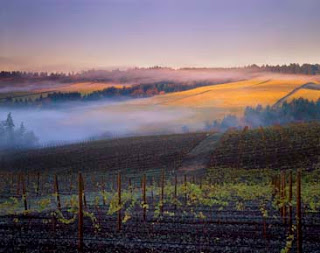
For example this photograph, Fog and Fall Colors over Willamette Valley Vineyards, was originally taken on 645 Velvia film, scanned and optimized. I usually complete the optimization adjustments in the following order: (Vineyard in foreground is Bella Vida and background is Knudsen in the Red Hills above Dundee, Oregon.)
1) If the image is not already in the Pro Photo RGB color space, I will convert it. I want all of my Legacy Images in this larger color space because in the future we will have the technology to take advantage of the additional colors.
2) Create a duplicate background layer which I spot for any dust. I like to have this duplicate layer in case the background layer somehow gets corrupted. I had one group of images where the background layer was corrupted by a bad Firewire cable connecting the working hard drive to the storage hard drive.
3) Begin with global adjustments, usually Levels and Hue Saturation.
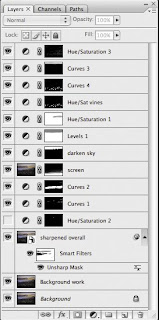
4) Although I didn't do so for this image, then I usually duplicate the dust spotted background, make it a smart object, and do a shadow/highlight adjustment.
5) Then I usually make fine adjustments to the image, beginning with large areas, continuing to smaller and smaller areas. Check out how monor adjustments affect the final image.
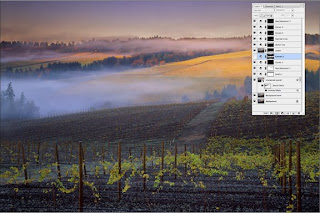
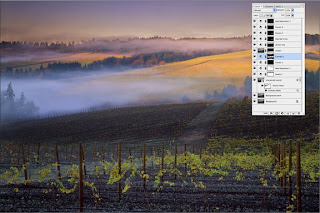
I'm not sure how clear this will be on some monitors, but I've darkened a selected area with a Curves Adjustment Layer.
6) Often I will use Select>Color Range to select and adjust specific color areas.
7) Finally, I'll duplicate the background (with the shadow/highlight adjustment if I've used that), make it a smart object (again if I've used shadow/highlight) and sharpen the image for the specific size it will be used. Notice that I've masked some of the sharpened layer so that not all of the areas are sharpened equally. By making the sharpened layer a Smart Object, I can change the amount of sharpening for each output. Remember that a 20X24 image for print needs more sharpening than a 72 ppi web image. With the Smart Object layer I can sharpen to size and need
8) Obviously I've saved the image as I work, but finally I save a Master File. This final master file needed to be saved as a PSB file–yes, that's PSB not PSD. With all of the layers, the 16 bit master file is 2.04 Gigabytes. Photoshop requires anything over 2 GB to be saved as a "Large Document Format" filed, thus PSB as in Photoshop Big.
9) I save the Master File on at least three separate hard drives, two in the studio and one which is stored off site.

For example this photograph, Fog and Fall Colors over Willamette Valley Vineyards, was originally taken on 645 Velvia film, scanned and optimized. I usually complete the optimization adjustments in the following order: (Vineyard in foreground is Bella Vida and background is Knudsen in the Red Hills above Dundee, Oregon.)
1) If the image is not already in the Pro Photo RGB color space, I will convert it. I want all of my Legacy Images in this larger color space because in the future we will have the technology to take advantage of the additional colors.
2) Create a duplicate background layer which I spot for any dust. I like to have this duplicate layer in case the background layer somehow gets corrupted. I had one group of images where the background layer was corrupted by a bad Firewire cable connecting the working hard drive to the storage hard drive.
3) Begin with global adjustments, usually Levels and Hue Saturation.

4) Although I didn't do so for this image, then I usually duplicate the dust spotted background, make it a smart object, and do a shadow/highlight adjustment.
5) Then I usually make fine adjustments to the image, beginning with large areas, continuing to smaller and smaller areas. Check out how monor adjustments affect the final image.


I'm not sure how clear this will be on some monitors, but I've darkened a selected area with a Curves Adjustment Layer.
6) Often I will use Select>Color Range to select and adjust specific color areas.
7) Finally, I'll duplicate the background (with the shadow/highlight adjustment if I've used that), make it a smart object (again if I've used shadow/highlight) and sharpen the image for the specific size it will be used. Notice that I've masked some of the sharpened layer so that not all of the areas are sharpened equally. By making the sharpened layer a Smart Object, I can change the amount of sharpening for each output. Remember that a 20X24 image for print needs more sharpening than a 72 ppi web image. With the Smart Object layer I can sharpen to size and need
8) Obviously I've saved the image as I work, but finally I save a Master File. This final master file needed to be saved as a PSB file–yes, that's PSB not PSD. With all of the layers, the 16 bit master file is 2.04 Gigabytes. Photoshop requires anything over 2 GB to be saved as a "Large Document Format" filed, thus PSB as in Photoshop Big.
9) I save the Master File on at least three separate hard drives, two in the studio and one which is stored off site.
Thursday, July 24, 2008
Oregon Wine in 50 years: Burgundy or Disneyland?
For my upcoming book, Oregon: The Taste of Wine, due out this October, I asked winemakers, winery owners and vineyard managers what will the Oregon wine industry look like in 50 to 100 years. Here are two responses:
I think that the Willamette Valley grows a variety in a style which appeals to a very narrow part of the palate. Where southern Oregon and eastern Oregon have climates and growing conditions that serve a much bigger part of the palate, the Cabernets, Syrahs, and Merlots. So in a hundred years, the Willamette Valley might become a little Burgundy, and the rest of Oregon might be where the action is, where the economic and industry growth takes place. It’s very possible that the center of gravity will change. Jim Bernau, Willamette Valley Vineyards
Economics won’t protect the vineyards. We’ve seen in Napa valuable vineyard land that is still more valuable for houses. The same is going to be true around Portland, if we let economics run the game. You could see the vineyards of McMinnville, Dundee, Carlton, Eola Hills all overwhelmed by the demand for housing. You could end up with this kind of vineyard in a terrarium, with a little glass dome over the cute little wine maker’s old pick up truck and his dog. You drive out and pay your fee to see them. It’s like a visit to the zoo. Ed King III, King Estate
What do you see in the future?
I think that the Willamette Valley grows a variety in a style which appeals to a very narrow part of the palate. Where southern Oregon and eastern Oregon have climates and growing conditions that serve a much bigger part of the palate, the Cabernets, Syrahs, and Merlots. So in a hundred years, the Willamette Valley might become a little Burgundy, and the rest of Oregon might be where the action is, where the economic and industry growth takes place. It’s very possible that the center of gravity will change. Jim Bernau, Willamette Valley Vineyards
Economics won’t protect the vineyards. We’ve seen in Napa valuable vineyard land that is still more valuable for houses. The same is going to be true around Portland, if we let economics run the game. You could see the vineyards of McMinnville, Dundee, Carlton, Eola Hills all overwhelmed by the demand for housing. You could end up with this kind of vineyard in a terrarium, with a little glass dome over the cute little wine maker’s old pick up truck and his dog. You drive out and pay your fee to see them. It’s like a visit to the zoo. Ed King III, King Estate
What do you see in the future?
Subscribe to:
Posts (Atom)