Sunday, March 30, 2014

Unique Architectural Panoramas capture it all

Over the past 15 years while I’ve been photographing apartment projects, I’ve looked for ways to capture wide architectural vistas, project views and especially difficult, the entirety of small furnished spaces, like those tiny studio units. Three years ago I started creating panoramas. It took nearly two years to perfect.


Saturday, March 29, 2014

Why Ethiopians put Coca Cola in red wine.

 While dining in an upscale local restaurant in Ziway, Ethiopia, (dinner US$1.49), I noticed the waiter serving red wine to the well-dressed trio at the next table. The waiter properly pulled the cork, and with a quick flick of his wrist, he poured out some of the wine onto the floor. Setting the wine bottle onto the table, the smartly-dressed waiter then popped the cap on a Coca Cola bottle and poured the contents into the vino bottle to replace what he had discarded. Then he served the mixed wine.
-->


Being a curious worldwide wine lover, I asked the waiter about this Ethiopian mixed drink. He replied, in a manner that subtly implied the whole world did it this way, “Ethiopians add Coca to red wine to decrease the alcohol content. And we add Sprite to white wine.”

Is this an idea for worldwide-designated drivers?

 
These are bottles of Red Wine and White Wine produced by Ethiopia's only winery prior to the French arriving several years ago as mentioned in a previous blog.


Friday, March 28, 2014

What happened when I gave cameras to remote tribes

For my First Stories (Undiscovered Myths) Project, I live with and study the Myths and Archetypal Dreams of Africa's most remote tribes, including the Mursi.
Since tourists flock to Ethiopia's remote Omo region to photograph the Tribes people, especially the Mursi women with the lip plates, I thought it would be fun to give Nikon cameras to the Mursi. My original idea was for the Mursi to photograph tourists as they photographed the Mursi, like everyone looking in a photographic mirror. Unfortunately, no tourists came to Belle, the remote village where I chose to live for a week in January of this year.

So what subjects did the Mursi--who are considered by far the most fierce of the Omo tribes—photograph for the first time in their lives? Well, duh, they photographed each other. 
Actually, the very first subject was me while taking a photograph of the first Mursi photographers. This was the first time they had ever held a camera.
Even the elders got into taking photographs. It did take this guy 3 snaps before he figured out he had to take his finger off the front of the lens.
No one did a selfie.
My personal Mursi guard, Mamoosh, became very popular with the ladies when he had the camera. 

My guide Andu, said that he had never seen the Mursi so "calm" as during our visit. Usually, the Mursi—the fiercest of the Omo tribes—are constantly agitating for something, like money.


Thursday, February 20, 2014

So, have you tried French-made Ethiopian wine?

On my way out to Ethiopia's Omo Region, I stopped by the new Castel Group Winery in the Rift Valley near the crossroads town of Ziway (Zeway) about 200 km south of Addis Ababa. I wanted to see what France's largest wine producer could do in the Horn of Africa.
At the entrance to the vineyards and winery a small army of friendly, but insistent guards greeted us.
After calling the winery to get permission for us to enter—I had no appointment, the uniformed guards thoroughly checked under our Land Cruiser. Fortunately, they found nothing but leaking oil. After a half an hour of convincing the winery manager how important I was as a visitor, the guards allowed us through.

What a first class operation with all shiny new French-made equipment. And current French winemaker since January 2011, Olivier Spillebout, knows how to grow grapes in the heat, as he made wine for Castel in Tanzania and Morocco before this Ethiopia gig.

Simple but elegant architecture.
For nearly a week, the team of local workers was efficiently bottling some of the one million bottles to be produced. And of course, the new oak barrels are all French.
They are bottling a red blend named after the region's ubiquitous thorny Acacia tree. Obviously, someone was thinking of their market.


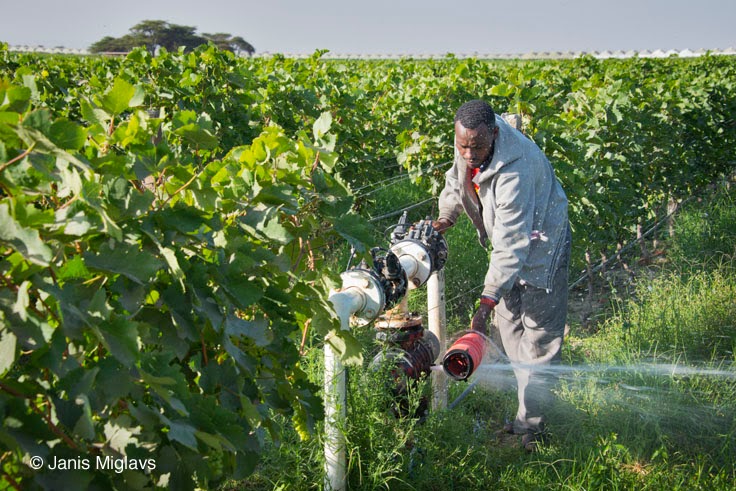
A worker washes a filter which is part of the sophisticated irrigation system used in the 162-hectare vineyard.

Admittedly my expectation bar was set rather low from my experience on a previous Omo trip with wine produced by the only Ethiopian-owned winery. The wines I tasted at this Castel winery left no doubt in my mind that the French know how to make wine, even in Ethiopia.
So where can you buy a bottle of this French-made Ethiopian wine after the first release later this year? 

Try Ethiopia.

Winemaker Spillebout explained that they are aiming for the local market first, then  expand into the Middle East. He never mentioned Europe or the USA. So if you want to try the wine, I suggest getting a cheap flight to Ethiopia. 

Sunday, December 22, 2013

My Faucet and Counting Blessings

Today I turned on the faucet to wash a dish. As the water poured of the faucet, my thoughts wandered to the Hammar family in Ethiopia's Omo region I photographed on a previous Myth Project trip. 

The older girl walks with her younger brothers about four miles round trip each day to get water. Each and every morning, they crunch through the parched landscape to water their cattle and fill containers for the family's daily needs. Four miles every day for water. 

All I had to do is turn on the faucet. Another blessing to count. 


Wednesday, November 27, 2013

Which one do you like best

I wanted to put a different vineyard through the view holes of this cobwebbed antique car. Then I couldn't decide which one I liked best. Which one works best for you?
1.

2.

3.

4.

5.

6.

7.

Tuesday, November 19, 2013

Woman with Grinding Stone causes Fall of Man

Suri woman grinding grain on stone in Tulgit, the Suri village in the Omo region of Ethiopia.
When I first heard this story, immediately I thought, “hey, wait, I know this narrative.” But this was a refreshing localized twist from one of Africa’s most remote tribes, the Suri (sometimes called Surma) in Ethiopia’s  Omo River region.

So the Suri account of the Woman with a Grinding Stone causing the Fall of Man, which elders often sing at gatherings, goes something like this:

Originally there were two people on earth, a man and woman. At the beginning, they had a direct connection to God with a rope that came down to earth. The man and woman could climb the rope at any time to be with God.  There was  only one rule: “do not to bring anything with you. Nothing. No possessions.” That was the system then, up and down between earth and God. 

One day the woman decided to bring her grinding stone on their visit to God. Hey, why not? She used it everyday to grind flour. When she started climbing with the stone under her arm, the rope crashed to earth.  First man and woman fell to the ground. Some say the rope was broken by the extra weight, others that God simply let it drop. Regardless, from then on the pair were stranded to live only on earth. They lost their direct connection to God.

My illustration of the Suri version of the Fall of Man.
I grew up with the Christian legend in Genesis chapter 2, where at first, Adam and Eve lived with God in paradise. When they break their only rule by eating fruit from the Tree of Knowledge of Good and Evil, God expels them from Eden. Their direct connection to God is severed.

When asked how old the oral Suri story might be, the reply was always something like: “It is very old” or “Much more than a hundred years.” A hundred years in a culture with no writing is a long long time, perhaps the beginning of man time on earth.  Since DNA tells us that we as Modern Man walked out from the Omo region to populate the earth, I conjecture that this Suri story just might predate modern religions.  What if the Genesis story is just a localized version of the Suri story?

Suri-tribe woman with her child in the Omo region of Ethiopia, Africa.
 Look at the similarities? Whose fault was the Fall in both stories? Did the misdeeds of the first Suri man and woman or Adam and Eve, ruin it for all of the rest of us?  What about the idea of sin?