Showing posts with label Ethiopia. Show all posts

Thursday, November 30, 2017

Here's happens after you die


LaBun, the famous Bume tribe storyteller in Ethiopia explained to me that when a person dies, he becomes the devil trickster with skin like a rock and a single horn. 


Even though he lives underground, the trickster can cause great mischief for the living. 

Do thoughts of a deceased person haunt you? 

Bume tribe, Omo region, Ethiopia, Africa

Thursday, May 26, 2016

What I didn't ask the farmer in the Birthplace of Modern Man.


In Ethiopia, for the Myth Project, I needed an image, a symbol, to represent agriculture in a more ancient time.

Driving on a remote pot-holed road out to the Omo region, I saw the perfect shot about a 1/2 mile away. A farmer working with a wooden plow pulled by oxen. The perfect ancient agriculture image.

Now, looking at the photograph on my 5K monitor one year later and 10,000 miles away, I regret not connecting with the farmer. 

Here he is working with same tools used by our ancient ancestors in the birthplace of Modern Man—Ethiopia, Africa. But he is in the 21st century. What gets him up each morning? What is his perspective about life on our planet? What are his dreams?


I only have a symbol, without the person. I could have had both.

Oh, what a huge opportunity missed. 

Tuesday, September 15, 2015

Shopping with no Costco in Jinka, Ethiopia


Before heading out for a couple of weeks with Ethiopia's Mursi tribe in Mago National Park, my guide and I wanted to stock up. So we stopped in the tiny market town of Jinka, Ethiopia. Please note that Costco and Walmart have not yet arrived in Jinka, Ethiopia.

The main road through Jinka's shopping district.
Since Costco has not made it to Jinka yet, this is the general store. Jinka, Ethiopia, Africa
Here you can buy your tobacco, other smoking grasses and a few spices.
And if you need furniture, this is the place in Jinka, Ethiopia.


Sunday, April 26, 2015

My photographs bring emotional magic to Ethiopia's Konso tribe.


One of my most moving photographic experiences ever was in the remote Ethiopian village of Busso. The photographs below were taken on two different visits: the first in 2001, then a return trip in 2007. On the second visit, I brought prints made from the slides taken on my first trip.  

The reactions to seeing the prints were tears, joy and pure delight.


Busso is one of my favorite villages in all of Africa. Konso tribe, Ethiopia.


In 2001, I photographed the old man on the left. There he was holding his pillow/chair staring out at the world through his hand-me-down glasses which still had the original sticker indicating the magnification. It turns out the old man died before my return trip. When I gave the print to the old man's son, he cried with joy. It was the only thing he had to remember his father by. I was so moved by the son's emotional reaction, I couldn't take photographs for a few moments.


On my first trip, I was fascinated by the scarification on the woman's face and her warm smile while holding her first child. When I showed her the photograph, she ran to get her children. The baby in the left photograph is now the taller of her two sons standing in front of her in the more recent picture on the right.


I love taking photographs of people doing everyday things, like this woman working her sorghum harvest. Six years later, on my return trip, the elders identified the woman and called her. She just kept running her finger over the photograph as if touching some distant memory.


I wonder if we technologically adroit Westerners have become immune to photography?


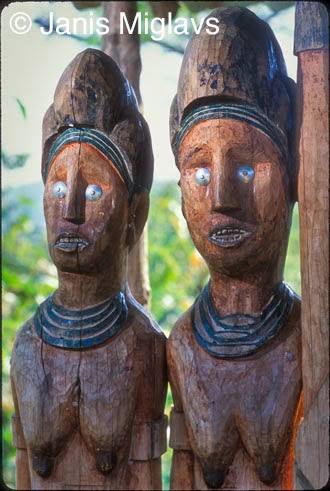
Collectors and museums steal these Konso tribe wooden statues


The Konso didn't think to preserve the wagas (wakas) until local and outside thieves began stealing them when the wooden statues became a red hot commodity for collectors and museums. They are cool looking.  Konso tribe, Ethiopia, Africa.

Wooden statues to honor their heros

Ethiopia's Konso tribe carves wooden statues called wagas (wakas) as grave markers to commemorate tribal heros. One elder defined a hero as either one who has been a good tribal leader/administrator or someone who killed a wild animal threatening the village. In the olden days, the tribe erected wagas for a warrior who killed an enemy. 

Since they are unique, collectors and museums from around the world have stolen many wagas. Naturally, the Konso have become quite protective of them. 

But I had spent days interviewing the elders to learn about their myths, stories and archetypal dreams, (plus I have a face even my wife's mother trusted—after I had been married for 8 years), so on both of my trips, amazingly, I was allowed free access to photograph all of the wagas. 


Originally these wagas (wakas) were totally exposed to weather's harsh erosion. Now a small tin roof (seen in the photo below) was errected. Konso tribe, Ethiopia, Africa.
Konso tribe, Ethiopia, Africa.


These are the hero's wifes in the grouping pictured below.  Konso tribe, Ethiopia, Africa.
The hero is the tallest wooden statue. The smaller ones surrounding him are his wives and children.  Konso tribe, Ethiopia, Africa.
This is the well prepared hero from the grouping pictured above. I could never find out why someone gave him a crown of vines. Konso tribe, Ethiopia, Africa.


I photographed these wagas on my 2001 trip. By my 2007 trip, they had disappeared. Konso tribe, Ethiopia, Africa.


This is the son of the hero for whom these wagas were errected. He is represented by one of the small wooden figures behind him on the left. Konso tribe, Ethiopia, Africa.


Konso tribe, Ethiopia, Africa.

Behind the father and his sons, you can make out the feet and torso of some family wagas. Konso tribe, Ethiopia, Africa.

On my second trip to the Konso, one of the village women challenged me when I wanted to photograph this site where waga once stood. The local culture minister jumped in to my rescue to explain I had permission from the elders. I must say, as you can see by his terse body language, he was a little harsh with the poor woman. I wanted to hug her and thank her for what she was trying to do. But me knowing only 20 words of Konso stopped me from any serious communication.  Konso tribe, Ethiopia, Africa.


On my first trip, I was shown this storage room full of wagas recovered from thieves. Then, with a smile, the caretaker offered me one. Wow, I could easily picture the wooden statue in my living room. But that was exactly the problem, so could lots of other collectors and museums. I declined the kind offer and took a photo to hang in my living room.  There is now a Konso Cultural Center displaying wagas.  Konso tribe, Ethiopia, Africa.


Thursday, January 8, 2015

The Ethiopian Mursi tribe turned their Botox equivalent into profit.


Tourists now flock to Ethiopia's Omo region to gawk at Mursi women with their clay lip plates. 

Originally created as a mark of beauty, now Ethiopia's Omo region Mursi women have turned their lip plates into a tourist attraction.  Ethiopia, Omo Valley, Mursi tribe, Africa.

Over the past 14 years I've traveled to the Omo, I've seen the Mursi turn their tortuous marks of beauty increasingly into Disney-like tourist attractions. "You, you, you. Photograph me." Now it costs 10 Birr a shutter click.

Watching the spectacle on my visit last January, I couldn't help but wonder how many of the camera-toting tourist's use Botox or other beauty treatments. 

It just seems to me that the Mursi have turned their Botox equivalent into profit.


Here a Mursi woman puts the finishing touches on a new clay lip disk.   Ethiopia, Omo Valley, Mursi tribe, Africa.
After shaping the clay disks, these Mursi women fire the plates in an open fire.  Ethiopia, Omo Valley, Mursi tribe, Africa.
  Since the Mursi have become such Disney-like tourist attractions, capturing casual relaxed photographs like these of women actually creating their lip disks would be very difficult. Today, it's like holding a greased pig at the state fair.  Now it is all about the money for each  shutter click.  Ethiopia, Omo Valley, Mursi tribe, Africa.
Besides the lip disks, Mursi women also pluck eye lashes to beautify themselves. On another note, when I took these photographs in 2001, it was my understanding that the women were not suppose to appear in front of foreigners without their disks inserted. Obviously, spending 5 weeks in the area made me less of a stranger.           Ethiopia, Omo Valley, Mursi tribe, Africa.
I can't imagine plucking my eye lashes.  And here you can clearly see what the stretched lip looks like without an inserted disk.    Ethiopia, Omo Valley, Mursi tribe, Africa.


All images copyright ©Janis Miglavs 2015


Tuesday, December 23, 2014

Can this Cattle Boy be the future of Africa?


I'm in the process of scanning thousands of slides taken during my early Africa film-only trips for the Africa's Undiscovered Myths Project. Here is one gem I rediscovered today.

Cattle boy. This young bare-footed Hamar tribe boy leads his family's cattle just over a mile to the water hole every day. Hamar (Hamer) tribe, Omo River Valley, Ethiopia.

Sunday, November 9, 2014

How Satan created Ethiopia's Crater Lake.


-->

On the way back to Addis Ababa from Ethiopia's Omo region, I wanted to stop at a crater lake I had heard about. While it is suppose to be a tourist destination, we passed the small rusty directional sign along the road several times, before finding the correct little road to the lake.

This emerald-green lake is in a deep crater about the depth of a 35 story skyscraper from the crater edge. I have no idea how deep it might be and a local told me it is deadly to throw a rock into the lake.

This panoramic photograph makes the lake look so small. But, in fact, you could put a 35-story skyscraper on the water surface and it would barely reach the height of the rim.
Actually, the local man—who walked from his nearby field of maze—told me that this scenic crater lake is an evil place. In fact, the lake’s name, Ara Shetan literally means “Lake of Satan”. 
 
-->
Many years ago, it seems that an evil sorcerer, who had fought with local peasants, was finally mortally wounded. He fell at the exact spot of the lake. With his last bit of energy as he was dying, he drove his spear into the ground, yelling a curse something like “let this be the devil’s home.” Suddenly, the earth below the dying Satan imploded, swallowed him up and the hole filled with a greenish water.


"Be careful. Don't throw a rock into the lake," my self-appointed guide told me.  It seems that the lake’s Satan will hurl the rock back with incredible intensity, killing the stone thrower.  


While today's geologists might have a different explanation for the lake's formation—something about shifting faults causing the hole—I decided it prudent not to throw any rocks into the lake.


Wednesday, August 27, 2014

Tribal architecture in Ethiopia's remote Omo region.


A contrast in tribal and contemporary architecture: my little old-fashion backpacking tent amongst traditional houses in a Suri (Surma) tribe village, Omo region, Ethiopia, Africa. Architects tell me that the cylinder of these houses is the strongest shape for a building.

Numbering approximately 28,000, the Dorze tribe was once known as fierce warriors. Now they are most famous for weaving cotton  cloths and these beehive-shaped huts.

It just happened that the day I arrived at the Aerbore (also spelled Arbore and Erbore) tribe, an elder of the village was getting married. There was a serious men-only "bachelor party" inside this traditional family house, located in the southwest region of Ethiopia's Omo Valley.

Nyangatom, also known as Bumi or Bume (which I believe translates as "stinking or the smelly ones"), are agro-pastoralists, growing sorghum by the Omo and Kibish Rivers. Besides fishing and raising cattle, they also hunt in nearby Omo National Park. Every time I was in the region, I would constantly hear how they were at war with the Karo, Hamer (Hamar) and Suri (Surma).

The Galeb (Geleb or sometmes I've heard them called Daasanech) tribe are agro-pastoralists, who live in Ethiopia's Omo region just north of Kenya's Lake Turkana.

The Hamar (also spelled Hamer) is a large tribe living in a number villages in Ethiopia's Omo region. They construct their homes and storage cylindrical buildings out of wood.

The Karo tribe, numbering somewhere between 1000 to 3000—depending who supplies the population figures—farm using flood irrigation on the Omo River. The smaller structures in the photograph are for storage, raised to keep rodents out of the harvested sorghum, maize and beans. In the background are homes. Although I didn't see this, I'm told very Karo family owns two houses: the Ono, the principal living room of the family, and the Gappa (not sure about spelling), which is the center of several house hold activities. Omo Valley, Ethiopia.

Many Konso villages are fortified by a stone walls as a defensive measure.  This is Busso village, located on the edge of a hill.  In order to enter Busso, you must pass through a gate and a series of stone-lined alleys.  These paths are part of it's security system, keeping the village difficult to access. Konso tribe, Omo region, Ethiopia.

This is a view from my favorite Konso village, Busso, showing the steep hillside location with agricultural terraces on the opposite mountain. Busso village, Konso tribe, Omo region, Ethiopia.

The lip-plate (dhebi a tugoin) has become the chief visible distinguishing characteristic of the Mursi and made them a prime attraction for tourists. - See more at: http://www.mursi.org/introducing-the-mursi/lip-plates#sthash.6aqp1ywk.dpuf
These storage buildings belong to the Mursi tribe, probably best known for the women wearing clay lip plates. Belle Village, Mursi tribe, Mago National Park, Omo region, Ethiopia.