Showing posts with label Oregon wine. Show all posts

Tuesday, July 17, 2018

Ten years ago Oregon The Taste of Wine came out. It's the book I'm most proud of creating. 


Oregon the Taste of Wine was first published in 2008. The publisher printed a second edition, with a few updates, a couple of years later. A second printing for a picture wine book is like finding a 1787 Chateau Margaux, just not as expensive.

Plus, it won all kinds of awards including Gold Medal for Best Regional Book and even snobby Wine Spectator called it "one of the best reads for wine lovers." 
 
Richard Sommer, founder of Hillcrest winery and rightfully founder of Oregon's modern wine industry, shows off a new camera to Dyson DeMara, who bought and continues production at Hillcrest.
And, it's still relevant today with surprising stories from folks like Richard Sommer, who had bottled Pinot years before Papa Pinot, who usually gets the credit. 

A big thanks to Jim Bernau and all the kind people who taught me the taste difference between California Ripple and Oregon Pinot noir.


-->

Sunday, August 17, 2014

Why working dozens of Willamette Valley vintages taught this Oregon Wine Pioneer to be optimistic.


Vineyard Light interview with Dick Ponzi, Oregon Wine Pioneer, whose first Willamette Valley vintages were in the early 1970s.


This is Ponzi's Mountain Home Road vineyard in the Chehalem Mountains with dramatic views of the Willamette Valley, located between Scholls and Sherwood, Oregon.


"It makes me feel good to walk through the vineyard. It’s like a hike in the mountains. Refreshing. After I take a 20-minute hike through the vineyards around our home, I come back refreshed, reinvigorated.


Fall colors on Ponzi's Mountain Home Road vineyard in the Chehalem Mountains, Willamette Valley, Oregon.


"The vineyard has also made me optimistic, rather than being a pessimist. There is the rebirth that happens every year. 

"After experiencing the variation of many vintages, I’ve learned that if things don’t go well this year, they will go better next year. I guess too that if there is a series of good years, there will be a bad year."


Dick Ponzi,  Oregon Wine Pioneer,  Ponzi Vineyards, Willamette Valley, Oregon.
Winter in Ponzi's Mountain Home Road vineyard in the Chehalem Mountains, Willamette Valley, Oregon. The tall white building in the background is an old walnut drying barn.


Sunday, July 27, 2014

Vineyard Light: Where is your seat on our tiny spaceship?


We travel huddled on a tiny spaceship hurtling through vast darkness.
                    Found in Janis Miglavs' Vineyard Journal


Morning clouds hover over Zerba Cellar's Cockburn Farm vineyard near Milton-Freewater in the Walla Walla AVA, Oregon. Considered rising star on the global wine stage, Walla Walla is in south eastern Washington, yet some of the best vineyards in the Walla Walla AVA are actually in Oregon. Owners Cecil and Marilyn Zerba have tasting rooms in both Milton-Freewater and Dundee, Oregon.

Sunday, July 20, 2014

Vineyard Light: Meet the former Director of the Universe.


 Philippe Girardet, Owner, Girardet Winery, Roseburg, Oregon
"If you are a perfectionist, the grape can drive you crazy."

Born and raised in Switzerland near the headwaters of the Rhone, Philippe Girardet grew up working in his great uncle’s vineyard. He immigrated to the USA to work as a design engineer at Cal Tec in the 1960’s. There he met and married Bonnie, who also happened to like European wines. While on a vacation in Oregon the two wandered into Umpqua Valley, where they decided to plant a vineyard and build Girardet Wine Cellars.


"Grapes want to be wild, you know. Perfection is a nice goal but you have to get perspective. There is a point that you have to let go, let life take its course. 

"I resigned my post as director of the universe."


A hen house on wheels parked in the 35 acre estate vineyard provides a hint that the Girardets use sustainable farming methods.  While there are at least 14 different varietals in the vineyard,  Philippe likes to brag about his Old Vine Baco Noir.

Saturday, December 8, 2012

The Wine Is Not Orange In Oregon

Looking at the warm salmon-colored fermenting juice in the glass, what varietal would you guess? 

Of course, it's Pinot Gris. But it's skin-fermented.   

Not exactly what you expect from a white wine. Aren't whites typically stripped from their tannin-holding grape skins to create the more familiar nearly clear Pinot Gris (AKA Pinot Grigio)?    

That's Dag Johan Sundby's hand holding a glass of Pinot Gris juice just taken from below the cap of skins and seeds. Sundby, a native Norwegian and owner of Johan Vineyards in the Willamette Valley near Rickreall, and his winemaker/viticulturalist Dan Rinke decided to try skin fermenting this year.
Actually, the technique is not so unique. At least one winery in New York is also experimenting with skin-fermentation. And it has been used for thousands of years in European regions like Slovenia, Georgia and Italy. 

While I haven't seen skin-fermented wine from other wineries, I've heard it called by the unappetizing title of orange wine. To me, those two words clash. If that title is an accurate descriptor of other winery's efforts, I must say that the salmon color produced Sundby and Rinke at Johan Winery is visually much more appealing. To a Northwesterner, salmon and wine make a perfect pair.

After tasting this uniquely-flavored fermenting juice, I can't wait to see the wine.

Thursday, November 15, 2012

Early Oregon Wine made in a German's barn

In 1860 Oregon's wine production was something like 2,600 gallons, but we're not sure how much was fruit wine as opposed to the Vitis vinifera fruit kind.
 

Sometime in the 1880s, two German immigrant brothers—Edward and John Von Pessls— ventured north from California to plant Zinfandel, Riesling, and some kind of Sauvignon in southern Oregon. When one of their German immigrant buddies, Adam Doerner, visited the Von Pessl brothers some time the 1890s, Doerner thought, "hey, I could make wine here in southern Oregon also."

So the aspiring winemaker brought some Riesling and Sauvignon (we wish he would have kept better records as to the specific varietal) cuttings from the Beringer Brothers in Napa to the Umpqua region (that's in southern Oregon for all the Rush Limbaugh fans who didn't know). And where do early Oregon winemakers make their creations, in the barn. 

Doerner's barn winery still stands, but without the wine making equipment.

You can read more about Oregon Wine history in my book, Oregon The Taste of Wine, available in bookstores and at Amazon.

Thursday, August 16, 2012

Have you ever seen a white rainbow?

While pulling some stock photos for a client, I came across this view I took last March over Bella Vida vineyard above Dundee in the Dundee Hills of Willamette Valley Wine Country, Oregon. I called it a white rainbow.
 Is it the same thing as this event seen from Cain Vineyard above Napa Valley?

Monday, July 30, 2012

Monks divide Burgundy at Oregon's International Pinot Noir Celebration

If you you had a magnifying glass for the fine print identifying the wines in the photograph, you would read that all the wines we sampled at the "Study Abroad in Burgundy" session at Oregon's International Pinot Noir Celebration in McMinnville are either Premier or Grand Cru wines. That means they represent the best Burgundy has to offer. It was a shame to spit, but it was 9:00 a.m..
At my very first session at the International Pinot Noir Celebration, I learned it was the monks who divided Burgundy into wine growing regions hundreds of years ago. The IPNC session was "Study Abroad in Burgundy".

Those Cistercian Monks first appeared on the European scene nearly a 1000 years ago.  They built their first abbey at Cîteaux (Latin Cistercium, hence "Cistercian") near Nuits-Saint-Georges.  It just happeed that several of the wines we tasted in the IPNC Burgundy session had roots in the region. It felt like I was tasting history.

As they grew grapes and made wine, those monks kept great records, according to moderator Allen Meadows, who spends 4 months a year in Burgundy when he visits more than 300 domaines and publishes Burghound.com—an e-newsletter specializing in Burgundy. Those monks started to notice that the wine from one parcel tasted different from the next, sometimes from adjacent plots. 

Fortunately, they planted lots of Pinot noir, the most terroir transparent of grapes, says Meadows. He claims the monks were tasting differences in terroir, in geography, in soil, in temperature.


The monks attributed the taste differences to God. For those pious monks, Pinot noir was only the messenger, not the message.


Regardless, those monks prospected for terroir. They planted vines everywhere but only kept those that were the most interesting. And they took meticulous notes, keeping volumes of hand-written records. So now Burgundy has hundreds of years of history of knowing what will grow best where.

Thus today, Burgundy is divided into many different appellations, sometimes covering only a single vineyard. In fact, Meadows said there were some 1600 different "climats"—a term unique to Burgundy which designates each plot or group of plots of vines which have been known under the same name for several centuries.


In the end, Meadows and the 5 Burgundian panelist—Bertrand Ambroise from Maison Ambroise, Cyril Audoin of Domaine Charles Audoin, Philippe and Vincent Lécheneaut of Domaine Lécheneaut and Jacques Lardière of Maison Louis Jadot—seemed to agree with the historic monks: Pinot noir was the messenger of Burgundy terroir.

Thank you monks. Thank you God.


Thank you Anne Amie Winery, one sunny IPNC host

This weekend at the International Pinot Noir Celebration (IPNC) conference at Linfield College in McMinnville, Oregon, highlight sessions were held at Willamette Valley wineries which were undisclosed to us mere attendees until we boarded the bus to the destination. I lucked out. Our bus—tour guided by Texan-turned-Oregon-winemaker Rollin Soles—ended at Anne Amie Winery. What an Oregon treat.
With glass in hand, vineyard manager Jason Tosch gave us a tour of the estate vineyard while we sampled the results.
Some found the production equipment especially relaxing.
Then a honest peek at what it takes to make great wine.
Can life get any better than lunch with a panoramic view of the Willamette Valley?


Thank you to all the wonderful people at Anne Amie Winery for providing such a memorable Oregon experience.

Thursday, November 11, 2010

Photos etched on wine bottles


For Salud–Oregon wine industries' fund raising event to provide health care for vineyard workers–we donated 4 vineyard photographs to be etched and painted onto 3 liter bottles of Erath wine. These will be auctioned at the event this weekend. Check out the great work Scott Schoenen and his crew at Fresh NW Design did in etching and painting the images onto the bottles. Let's see how much the effort brings in.

Thursday, November 4, 2010

Oregon Harvest 2010

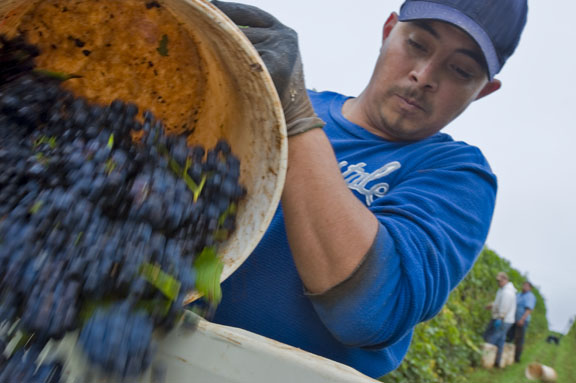
Some claim Oregon never saw a summer this year. It did rain. Our neighbor and one of our winery friends didn't even harvest because of rot. But I photographed vineyards which were carefully managed and sprayed often that produced some great tasting fruit. Harvesting in late October and early November permits some great hang time. Ask the early Oregon wine pioneers who regularly harvested in November. While I'm not an expert, I'm looking forward to some interesting 2010 wines.
For me, it's always great to brush up on my Spanish to photograph Oregon harvest workers. These photographs are from Turner-area Willamette Valley Vineyards and Dundee-area Prince Hill vineyard which provides fruit for Erath winery.


Monday, April 19, 2010

Can lines & patterns survive the mid-life photo crises?

Have you ever had a mid-life photo crises?

I'm there. I want to re-examine my career, my future and what makes a strong photograph in the post-darkroom era. Can the old rules of photography still hold true in the digital age? And heck, what's the future of photography itself?

So in this agitated state, I avoid the future of photography question and get back to editing images for a print magazine. The idea of income to pay bills hasn't changed a bit. There I am staring at a couple of photos I like. So why do I like these photos?
Well, they have graphic lines and repeated patterns. I also like the human element.

What do you think? Can graphic lines and repeated patterns still make for an impactful (is that an official word) photo in the digital age? Or is that too old fashion?

Saturday, April 17, 2010

Failure, failure, failure, success: the power of composition.


While snapping this great graphic pattern in a naked vineyard, I wished there were a worker or something human to give the scene scale.


Thank the photo spirits or some higher power or something. While hiking back to the winery here comes the man-on-a-green-John-Deere answer to my wish.


I rushed back to my graphic line photo site to snap this photo. But the foreground was too cluttered.


Less foreground clutter, but still too busy. Visual simplicity makes for poetry.


Much better, but the tractor is headed out of the frame. Photo seems compositionally too heavy on the right. It wants to fall down to the right.


Luck (or the photo spirits) were with me. The tractor worker turned around to take another pass at tilling the road. Click. I like this view the best because it's: 1) balanced like good wine, 2) the tractor is angled showing action and 3) the tractor angle opposes the diagonal lines of the rows of vine.

Where does your eye wander in this photo? What first attracts your eye? What happens when you get to the tractor? Does you eye get kicked out of the frame?