Showing posts with label Photography and wine. Show all posts

Monday, January 11, 2016

Wine Photographer Janis Miglavs seen in Photo District News


For the non-photographers, Photo District News is the magazine targeted towards professional photographers. So now after 40 years of using a camera to support a family and lifestyle, can I officially consider myself a professional photographer?


Before I head out on each assignment, I do this little meditation to clear my mind, so I'm approaching every winery with an explorer's excitement about seeing it for the first time. So no matter how many wineries I've visited, it/s fun and a brand new experience.


Workers in the vineyard at Changyu AFIP Global winery, Ju Gezhuang Town, Beijing city area, Miyun County, China. China wine country.

Vineyards in Beng (also called Bu) village on LanCang (also called Lantsang, Lansang and Mekong) River, in the Heng Duan (Hengduan) Mountain Range, Yunnan Province, China, Asia. China Wine country.

North America, USA, Washington, Washington, Yakima Valley, Yakima county. Stone chapel a top of Syrah vines at Red Willow Vineyard in the Yakima AVA.

The sun sets behind San Vicente de la Sonsierra village perched on a hill top overlooking vineyards in La Rioja region of northern Spain.


Winemaker Paul LeRoy in the barrel cellar at Hermannhof winery in Hermann, Missouri, USA.

Please respect that all images are copyrighted 
© Janis Miglavs 2015
janis@jmiglavs.com


Monday, January 7, 2013

Denial doesn't work

Found in Gevrey-Chambertin, the largest appellation in Burgundy Cote de Nuits.

Friday, November 30, 2012

Never Let Them See You Sweat?

How many winemakers, creatives and yes, even photographers, who really care, expose the grit, determination and work it takes? I've just learned that "never let them see you sweat" is bad advice.

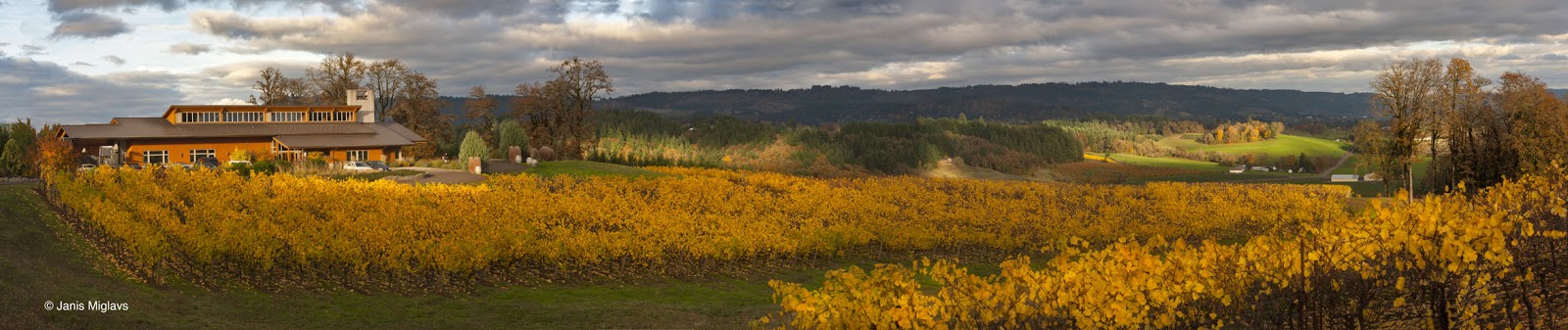
Fall Breaking Storm over Penner Ash Wine Cellars and the Willamette Valley.
After adjusting each of the 21 individual frames in the RAW File Converter, I stitched this panorama together. But it has rough edges and flat contrast, even after adjusting before stitching.
Check out the adjustment layers that created the more painterly look below. Each area is carefully selected and painted. This is the kind of work I did on canvas during my Masters of Art Degree.
I'm working to create an emotionally engaging image; one that brings joy and a sense of awe.
Isn't it the sweat that makes a piece of work individual?

Thursday, November 29, 2012

After a glass of Pinot, I apologized to Ansel Adams

Over Thanksgiving I struggled with perfection. 

Visiting friends and relatives wanted to see photographs from the September France trip my wife and I took. Groaning, I gave my all too often reply, "the photos are not optimized."

To me, that meant the photos are not ready for Ansel Adams-level show time.

Things haven't changed all that much since the film days of Ansel. A photograph from any digital camera is just raw material used to make the final image. In fact, I shoot in RAW format, which provides a pile of digital data that need to be interpreted. That interpretation is like Adams' idea of "the negative is the score, the print is the performance."

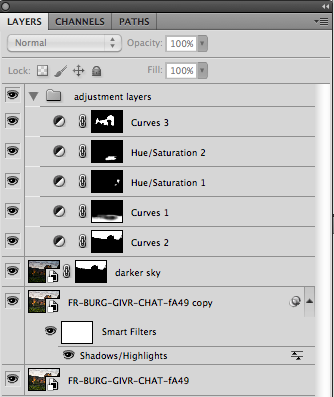
But creating a performance is a lot of work. After making a dozen or so big adjustments in the RAW file converter, I literally paint minute adjustments with Photoshop layers. Check out the screen capture of my layers palette for this simple photograph of the Gevrey Chambertin Chateau (recently bought by a Chinese businessman).

Photo as it came from RAW File Converter with about 6 basic adjustments.
Notice the addition of a sky layer with a stack of adjustment layers on top.
The final photograph has much more drama.
 The image becomes a painting, a visual performance.

But, if each France-trip image took 5 to 15 minutes to optimize, it would require at least 60 hours of painting to create a simple 100-image Holiday "slide show." (Add to that, first, I had to edit the 11,000 or so images I took during the three-week trip.)

I had to let go of perfection.

That's where wine came to the rescue.  After a glass of Oregon Pinot from White Rose Winery, I "optimized/painted" some key images—three hours—and used the JPGs straight out of the camera for the rest of the show—one hour. The show was done. Simple. No perfection.

Sorry, Ansel, it wasn't a stunning performance. But it was good enough.


Thursday, August 16, 2012

Have you ever seen a white rainbow?

While pulling some stock photos for a client, I came across this view I took last March over Bella Vida vineyard above Dundee in the Dundee Hills of Willamette Valley Wine Country, Oregon. I called it a white rainbow.
 Is it the same thing as this event seen from Cain Vineyard above Napa Valley?

Monday, July 30, 2012

Monks divide Burgundy at Oregon's International Pinot Noir Celebration

If you you had a magnifying glass for the fine print identifying the wines in the photograph, you would read that all the wines we sampled at the "Study Abroad in Burgundy" session at Oregon's International Pinot Noir Celebration in McMinnville are either Premier or Grand Cru wines. That means they represent the best Burgundy has to offer. It was a shame to spit, but it was 9:00 a.m..
At my very first session at the International Pinot Noir Celebration, I learned it was the monks who divided Burgundy into wine growing regions hundreds of years ago. The IPNC session was "Study Abroad in Burgundy".

Those Cistercian Monks first appeared on the European scene nearly a 1000 years ago.  They built their first abbey at Cîteaux (Latin Cistercium, hence "Cistercian") near Nuits-Saint-Georges.  It just happeed that several of the wines we tasted in the IPNC Burgundy session had roots in the region. It felt like I was tasting history.

As they grew grapes and made wine, those monks kept great records, according to moderator Allen Meadows, who spends 4 months a year in Burgundy when he visits more than 300 domaines and publishes Burghound.com—an e-newsletter specializing in Burgundy. Those monks started to notice that the wine from one parcel tasted different from the next, sometimes from adjacent plots. 

Fortunately, they planted lots of Pinot noir, the most terroir transparent of grapes, says Meadows. He claims the monks were tasting differences in terroir, in geography, in soil, in temperature.


The monks attributed the taste differences to God. For those pious monks, Pinot noir was only the messenger, not the message.


Regardless, those monks prospected for terroir. They planted vines everywhere but only kept those that were the most interesting. And they took meticulous notes, keeping volumes of hand-written records. So now Burgundy has hundreds of years of history of knowing what will grow best where.

Thus today, Burgundy is divided into many different appellations, sometimes covering only a single vineyard. In fact, Meadows said there were some 1600 different "climats"—a term unique to Burgundy which designates each plot or group of plots of vines which have been known under the same name for several centuries.


In the end, Meadows and the 5 Burgundian panelist—Bertrand Ambroise from Maison Ambroise, Cyril Audoin of Domaine Charles Audoin, Philippe and Vincent Lécheneaut of Domaine Lécheneaut and Jacques Lardière of Maison Louis Jadotseemed to agree with the historic monks: Pinot noir was the messenger of Burgundy terroir.

Thank you monks. Thank you God.


Thank you Anne Amie Winery, one sunny IPNC host

This weekend at the International Pinot Noir Celebration (IPNC) conference at Linfield College in McMinnville, Oregon, highlight sessions were held at Willamette Valley wineries which were undisclosed to us mere attendees until we boarded the bus to the destination. I lucked out. Our bus—tour guided by Texan-turned-Oregon-winemaker Rollin Soles—ended at Anne Amie Winery. What an Oregon treat.
With glass in hand, vineyard manager Jason Tosch gave us a tour of the estate vineyard while we sampled the results.
Some found the production equipment especially relaxing.
Then a honest peek at what it takes to make great wine.
Can life get any better than lunch with a panoramic view of the Willamette Valley?


Thank you to all the wonderful people at Anne Amie Winery for providing such a memorable Oregon experience.

Tuesday, June 12, 2012

WA Wine Tour Guide cover

Wow, did you see the great shot on the new Washington Wine Tour Guide? 

Oh, wait, that's my photograph.

Thursday, June 17, 2010

Will vineyards survive humans on earth?

This Lesson from the Vineyard i-post card number 2 really speaks to me: the wild stormy earth image with words about basic human survival. Primortial.

The genesis: I was fortunate enough to spend about a half day with Chris Howell, the general manager and winemaker at Cain Vineyard & Winery while he drove me around the vineyard in his 4-wheeler. As we stood in the howling wind on the narrow ridge that divides Napa Valley from Sonoma, Chris started talking about really heavy stuff. As we stood outside, I couldn't take notes as the wind buffeted my notebook and all my little Olympus digital recorder captured were powerful wind sounds as it wiped over the stereo microphones. Dummy me, I didn't think to have our
life lessons conversations inside his car. But somehow the powerful wind somehow matched his words. So I got only a small sampling of Chris Howell's Lessons.

The next morning barrels of rain flooded Napa streets. Perfect.

So I spent about a half day on the Cain vineyard ridges in the rain
huddle under my tiny red umbrella with my plastic-bag covered D3, waiting for cloud breaks. Pure magic happens during those breaks. Waiting. Waiting. Woa, suddenly clouds lift off the mountains, pieces of sun gently touch the soaked landscape. All the while brooding threatening clouds hover just overhead. Perfect. Click. Click.

Who else should I interview for Lessons from the Vineyard?

Wednesday, June 16, 2010

Tasting sweat in rice and wine

I've been sending out i-post cards as part of a Lessons from the Vineyard series. The idea is to find a synergy between photography and words.

The whole thing started as a book project where I'm asking winemakers, owners, vineyard workers what life lessons they have learned from being in the vineyard. The goal is 100 interviews. So I'm talking with folks from the whole socio-economic spectrum, some don't speak English, some are very famous Napa winemakers, some are well-known wine writers like Eric Asimov, even Tim Mondavi and Francis Ford Coppola are on the list.

Right now I'm at about number 56 of the magic 100 goal and seeing totally different perspectives of and insights on life through the vineyard prism.

This quote is from Sue Parry, owner with her winemaker husband of Parry Cellars, a one acre front-yard Cabernet sauvignon vineyard/winery in Napa Valley. During our talk, Sue focused on the workers. When she works in the vineyard and it gets too hot, or too cold or too rainy, she says she quits. The workers can't.

One of the most interesting comments
from the dozens we received from this the Number 4 of the Lessons series was from my friend Edward Dong, who just quit working for China's largest winery to earn his PhD. He wrote: "in Chinese we also have such kind of proverb, 'Every rice in our plate contains the sweat of farmers.'"

So can you taste the sweat of the vineyard workers?

Tuesday, May 4, 2010

Dangerous Rorschach clouds over vineyard

It's not often that nature provides a psychological test for insights to wine lovers' perceptions. But on one rare Fall day in the Red Hills above Dundee, Oregon, such an opportunity momentarily displayed for all to do a Rorschach self examination. As a highly trained Rorschachian photographer, I was able to wrestle the moment onto my camera's digital sensor.

Before you read any further about the dangers of this test, What do you see in the photo? Hey, be honest.

As you know, psychologists use the non-organic ink-blot version of this test to examine a wine lovers' personality characteristics, emotional functioning and booze-absorption ability. It has been employed to detect any underlying thought or tannin-identification disorder, especially in cases where patients are reluctant to describe their thinking or drinking processes openly–as in most men.

In a national survey in the U.S., the Rorschach was ranked eighth among psychological tests used in outpatient mental health facilities but rarely used in tasting rooms. According to my dentist and Wikipedia, it is the second most widely used test by members of the Society for Personality Assessment, and it is requested by psychiatrists in 25% of forensic assessment cases. Please note this is not the same test the State Patrol gives out on the highway after they pull you over.

Please do not take this test alone or without a glass of wine or root beer nearby. Please also note that nether the photographer, wine industry or God are responsible for any damage you might suffer from viewing the image.

So what are you seeing in the photo?


Sunday, December 28, 2008

Photoshop and winemaking

Is making wine like using Photoshop?

In their book, The Creative Digital Darkroom, Katrin Eismann
and Sean Duggan write: "...it is common for students to focus first on the details of how to do something in Photoshop rather than focus on the image itself." They contend: "Before you even
start pondering whether to use Curves of Levels, you should take a good look at the image and see what it tells you."

Listen to the picture.

So is making wine similar? Do wine makers listen to what the wine tells them?


Winemaker Forest Klaffke and his team at Willamette Valley Vineyards set out the wine they will taste this day.