Showing posts with label Chinese wine regions. Show all posts

Friday, August 1, 2014

Why are there so many bare-breasted European women at Chinese wineries?


In reviewing some of the thousands of photographs from my last few China wine country trips, I noticed lots of bare- breasted European women standing around at many of the chateaux. Do they look somewhat out of place in China?

This bare-breasted beauty greets the tourist at Dynasty Winery's Tianjin Chateau in Tianjin municipality, China. Also note that the Chinese love to lift ideas from other cultures, like the Louvre glass Pyramid in the Chateau courtyard. Perhaps it is a nod to French partner, Remy-Martin as Dynasty Winery is a Sino-French joint venture.

OK, she isn't topless as promised. This lovely lady with a semi-Mona Lisa smile and skin-hugging dress is part of an all female crew which has been stomping grapes for years in the Grape Maiden Plaza at Chateau Changyu-Castel.          The Chateau is a Sino-French joint venture between China's oldest, largest and most famous winery, Changyu, and Groupe Castel of France, one of the top three wine companies in the world.             To meet this woman yourself, just head to Beiyujia Village just out of Yantai in Shandong Province.

This bare-breasted beauty holds her basket of grapes in the garden at Dynasty Winery's Tianjin Chateau in Tianjin municipality and province, China. Dynasty Winery is a Sino-French joint venture with the French producer, Remy-Martin.


These woman holding empty ceramic pots must be waiting for their wine allotment in the courtyard at Chateau Changyu Moser XV at the edge of Yinchuan, Ningxia, China.

The statues are right out there for all visitors to see. But I wonder why these wineries show so many provocative females in a country where censoring pornography is a government priority?  

And why just western women? Why not Chinese? Don't the Chinese appreciate Chinese women?

This nearly-naked European beauty lies at Dynasty Winery's Tianjin Chateau in Tianjin municipality and province, China. Dynasty Winery is a Sino-French joint venture with the French producer, Remy-Martin.
Behind the squirting water, lightly-clad women watch wedding photographers work with a newly hitched couple behind the fountain at Chateau Changyu Moser XV on the outskirts of Yinchuan, Ningxia Hui Autonomous Region, China,

This curvy maiden somehow lost her hand while showing off her shapely leg at the local government-owned estate Chateau Lanny (Lanyi), near Yinchuan in the Ningxia Hui autonomous region, China. The grape vine springing from her head seems to be a local phenomenon.

The 630 million yuan (US$103 million) Changyu Chateau Baron Balboa, with its 6,000-square-meter cellar and production facilities, would not be complete with out some scantly- clad maidens. Obviously, the desciplined workers are focused on their tasks. This is the fifth chateau for China's largest wine producer, Changyu. Shihezi, Xinjiang Uygur autonomous region, China.


Perhaps you the reader could help me solve the mystery.  Could it be that almost all Chinese wineries are CEOed by Chinese men? (Grace is an exception.)

Are there so many bare-breasted women at wineries in other countries?

Definnitely alive, this dancer was performing at joint-venture Chateau Changyu-Castel winery as part of the Yantai International Wine Festival, Yantai, Shandong Province, China.  Just as a side note, all of the Changyu executives I know are male.

Saturday, July 12, 2014

Wineries in China's hottest wine region, Ningxia.

              
      Changyu Moser XV, Ningxia
Night-time light show at Chateau Changyu Moser XV in Yinchuan, Ningxia Hui Autonomous Region, China.
Changyu believes in educating visitors at Chateau Changyu Moser XV in Yinchuan, Ningxia Hui Autonomous Region, China.

Changyu provides a Disney-like experience at Chateau Changyu Moser XV in Yinchuan, Ningxia Hui Autonomous Region, China.
  

Moët Hennessy's Domaine Chandon Ningxia
Moët Hennessy broke ground on April 2012 on Domaine Chandon Ningxia of this modern winery in Yinchuan, Ningxia Hui Autonomous Region, China.
Formal dinning room at Domaine Chandon Ningxia in Yinchuan, Ningxia Hui Autonomous Region, China.


     Silver Heights Winery, Ningxia
Tired of depending on local farmers, Emma Gao and her family of Silver Heights Winery have purchased land parcels near Helan Mountain to plant their own vineyard Ningxia Hui Autonomous Region, China.
While French-trained winemaker Emma Gao is in a business meeting, her winemaker husband Thierry Courtade and her father, Gao Lin proudly hold a photograph of their family-owned Silver Heights winery in the newly-released China The New Wine Frontier book. Far right is author and photographer of the book, Janis Miglavs. Silver Heights is located in urban Yinchuan, Ningxia Hui Autonomous Region, China.


 Chateau Yuanshi Winery, Ningxia
Chateau Yuanshi (Yuan Shi) Winery designed in local Chinese architecture and build from local stone near Yinchuan, in Ningxia Hui Autonomous Region, China.
Worker filling French oak barrels at Chateau Yuanshi Winery near
Yinchuan, in Ningxia Hui Autonomous Region, China.


             Ningxia Chateau Lilan Winery
French-trained Chinese winemaker Deng Zhongxiang, sits under illustrations of the Ningxia Lilan Winery currently under construction near Yinchuan, in Ningxia Hui Autonomous Region, China.

Chateau Lilan Winery currently under construction near Yinchuan, in Ningxia Hui Autonomous Region, China.


Ningxia Chateau Lanny Winery and Resort
Local government-owned estate chateau Lanny (sometimes seen incorrectly spelled Lanyi) Winery and Resort near Yinchuan, in Ningxia Hui Autonomous Region, China.


Ningxia XiXiaKing Chateau Yuquan Winery 
Chinese style Yuquan International Wine Chateau of Xixia King near Yinchuan in Ningxia Hui Autonomous Region, China.
Lobby of newly opened hotel next to Xixia King Chateau Yuquan near Yinchuan, in Ningxia Hui Autonomous Region, China.


COFCO's Great Wall Winery, Ningxia
COFCO's Great Wall Winery at the base of Helan Mountain in Ningxia Hui Autonomous Region, China.


Ningxia Daylong Winery
With it's fairytale castle-like architecture, Ningxia Daylong Winery, run by the Thailand-based Daysun Investment group, has Helan Mountain as a background, Ningxia Hui Autonomous Region, China.

Wednesday, June 11, 2014

This Ningxia winery changed my perception of Chinese craftsmanship

When you think of Chinese workmanship, what words come to mind? 

For me, after visiting wineries all over China for the past five years, the descriptors include: Bigger is better, Showy, Poor craftsmanship, Mass produced, Cheap, It won't last long.  I would not have included: hand-crafted with pride.

Yuanshi winery near Yinchuan city in Ningxia Province changed that.

All of the buildings are crafted from local stone. The businessman owner, Mr. Yuan, designed the structures himself, built the winery complex on his family farm all from stone found in the area. 

In the piercing Ningxia desert sun, I watched one craftsman chisel a design of straight lines on a granite-like building block. It will take him five days to finish carving just this one stone.


I can only imagine going into a Zen-like state to chisel this one stone for 10 hours a day.

All day long this craftsman works in the piercing Ningxia desert sun to hand carve a design in the stone. It will take him five days to finish this one building block.
One goal of the owner is to provide jobs for the local people.
Entrance to YuanShi Winery with Helan Mountains in the background.
If the owner takes this much effort to build the winery, imagine the wine. Remind me to talk about that wine in a future post.


All images international copyright 2014 Janis Miglavs.

For a more comprehensive look at the China Wine industry see my recently released book China The New Wine Frontier written in both Chinese and English. (The book already won the "Best in the World" award from Gourmand.)

To order the book in China go to Amazon China. 

To order in the USA or internationally, contact the author/photographer at janis@jmiglavs.com.

Monday, May 7, 2012

Getting to the CiZhong Vineyard


Working on the Yunnan section of my Chinese Winery book today.

It took us almost three days along this road to get to Cizhong Church and vineyard that I wanted to include in the ShangriLa winery shoot. The church was originally built by French missionaries in 1867. The missionaries are buried in the nearby cemetery.

Saturday, April 21, 2012

Golf in China

While working on my Chinese Winery book, I come across the strangest sights. This is the view from the Junding Winery golf course near Penglai, Shandong Province, China.

Friday, April 20, 2012

Chinese vineyard near the Glaciers

Here I am editing photographs of the vineyards in Yunnan Province near Tibet for the Chinese Winery book.

Check out the glaciers, part of the
Mingyong
Glacier Park, towering above the vineyard at Minyong village (also written Mingjin) at the entrance to the Park near LanCang (also called Lantsang, Lansang and Mekong) River, in the Heng Duan (Hengduan) Mountain Range, Yunnan Province, China, Asia.

Did you see the person at the edge of the lower vineyard?

Wednesday, April 18, 2012

Xinjiang Province in one photo

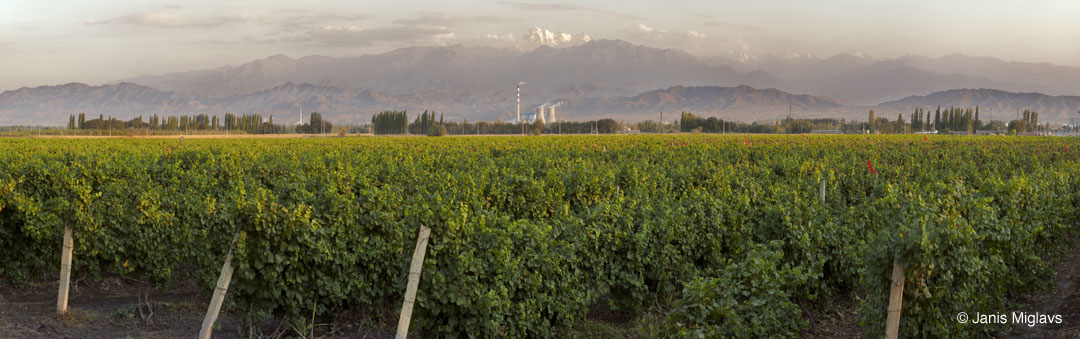
This photograph sums up the Xinjiang Province for me: grapes, nuclear power, lots of construction and incredible landscape.

Premium Cabernet Sauvignon vineyard where Citic Guoan Winery (known as Citic Guoan Wine Sales Co., LTD and formerly Suntime International Wine Company) gets grapes, with a nuclear power plant and Bogda Peak in the Tian Shan Mountain range, Fukang, Xinjian Province, China, Asia
.

Monday, January 30, 2012

What should I include in a China Winery book?

It's official. But now I need your help. I have a contract with a Chinese publisher to produce a China Wine book. They even paid an advance (in US dollars).

After the publisher, their adviser, Edouard Cointreau, and I choose 10 Chinese wineries as a focus, I determine text and photos. The book will be published in both Chinese and English for a Chinese and Western market.

So here's where I need your input.
What do you think should be included in the book?
What would you like to know about Chinese wine, wineries and vineyards?
Vineyard workers at Chateau Changyu AFIP, one hour out of Beijing. This Winery will definitely be in the China Winery book.

Saturday, December 10, 2011

See China via Her Wine Growing Regions

I'm constantly asked what China's wine growing regions are like. Follow along on the map while you visit nine regions.


Yunnan province. These two photos are taken near the border with Tibet. The vineyards are generally at elevations up to 10,000 feet. (probably the highest vineyards in the world.) While other wineries–like Yunnan Red–operate at lower elevations near the provincial capital of Kunming, Shangrila winery sources fruit from these remote high-elevation vineyards. Except for the transportation logistics,
in my opinion this is an amazing terroir for the likes of Cabernet Sauvignon and Merlot.

Shaanxi province. Jade Valley Winery's vineyard seen from the soon-to-be-completed resort, takes on a mystical quality while a heavy-rain storm clears. Just a bit over one hours drive from the famous Xi'an's Terra Cotta Warriors, architect/owner Qingyun Ma's vision is to build this resort and winery in his home town.

Shandong province. China's best known and most developed wine region. The top photograph pictures the landscape around Chateau Junding Winery and Resort in the area known as NAVA Valley–a name that irks California's Napa Valley. The second photo is from the historic hill behind Treaty Port Winery looking out towards the area near where Lafite is planting a vineyard.

Ningxia province. The Yellow River cuts through this upcoming wine region in China's wide-open north central desert region. The top photograph shows one of Pernod Ricard's Domaine Helan Mountain vineyard. The second photo, taken from the winery roof, shows Helan Qing Xue Winery's vineyard–recent winner of Decanter's International Wine award–with Helan Mountain in the background. You can see just how sandy the soil is in the vineyard leased by Dragon Hollow Winery in the bottom images.
To help them survive, vines are buried during the freezing harsh winters.

Xinjiang province. This is China's wild west. Vineyards are planted in the desert in sand dunes as seen in the second photograph background. Irrigation water flows from the huge surrounding snow-capped mountains.


Shanxi province. Probably one of the most scenic vineyard sites sits above Yellow Valley. Grace Winery, pictured in the second photo, sources fruit from these vineyards.


Heibei province. Top photo is Rongchen's vineyard. Center is Bodega Langes and bottom is Great Wall.


Tianjin province. Dynasty Winery sources fruit from this vineyard. Note the other crops planted between rows of vines.


Beijing area. One freeway hour from Beijing, here's the view from Chateau Changyu AFIP.