Showing posts with label China adventure. Show all posts

Tuesday, September 22, 2015

China's toilet revolution


China’s tourism association has started a new campaign for travelers to the country’s most scenic spots. It's called the “toilet revolution.”

This toilet at a nice Deqin, Yunnan province, restaurant is actually not too bad by current standards. No distinctions made here between the men's and women's side. I'm not sure the significance of the different colors on the baskets. If you need to ask how the baskets are used, please email me privately. Peoples Republic of China


The first goal is making sure sufficient supply to meet demand.  

If visitors have to wait in lines, claim the Chinese tourist officials, it can try their patience and detract from their travel experience. The campaign goal is to make sure waiting times at the country’s top scenic attractions do not exceed 10 minutes.

To help shorten those trying lines, China will build 33-thousand new restrooms and renovate another 24-thousand around the country by the year 2017.

The doors are wide open to a public toilet in Fukang.  Asia, China, Xinjiang Province, Xinjiang Uyghur Autonomous Region, Changji Hui Autonomous Prefecture.

To ensure compliance, China’s official Xinhua News Agency reports that over the next month, groups will conduct random inspections throughout the country. No mention of job qualifications for the inspectors.
   
Local governments are also getting involved.  Fortunately my favorite province, Yunnan, plans to spend about 10-million dollars over the next couple of years to build or upgrade 600 restrooms to what government officials call  “three-star rated.”

Personally, I am relieved at news of China's toilet revolution.


I wonder if this is part of China's "toilet revolution"? This was a prominent feature in the men's bathroom of the nicest hotel in ShangriLa, Yunnan Province, People's Republic of China.


All photographs and text © 2015 Janis Miglavs
www.jmiglavs.com
janis@jmiglavs.com

Sunday, November 9, 2014

China The New Wine Frontier: a wine lover’s photographic journey.


The straight rows of vineyards can be seen in remote Beng village in Yunnan Province near the border with Tibet. This is just one of the vineyards visited in my China The New Wine Frontier book and presentations.

China is now the world's largest market for red wine, having increased more than 136% since 2008. In France, the second largest consumer of reds, it has declined by 18%. Small wonder that Chinese wineries are springing up like Oregon mushrooms to meet the tremendous demand in their own backyard.


Yet most people outside of the Land of the Dragon have no idea about the country’s booming wine industry, or that the country’s wine history actually dates back at least 9000 years. 

Marco Polo rated the wine in far west Xinjiang, China during his Silk Road journeys, even suggesting a wine mixture for mad dog bites.


With a cow-powered plow, these farmers are pulling up the peanuts grown between rows of Cabernet Sauvignon in a Tinjian Province vineyard.

Join Janis Miglavs for a photographer’s and adventurist’s visual journey through parts of China and an incredible wine scene seen by few outsiders.  Get a behind-the-scenes peek at the booming industry. See the architecture, the vineyards, the people and the wine. 
 
This is how Chinese drink wine. They call it ganbei.

Along the way learn secrets like how to survive drinking wine with local Chinese during the common practice of ganbei.


The general manager at Chateau Changyu Baron Balboa in Shihezi, Xinjiang, holds up a copy of my China The New Wine Frontier book opened to a page showing another Changyu winery, Chateau Changyu AFIP Global.


Since it is only available in China at this time, these presentations are a rare chance to buy China The New Wine Frontier book, the definitive work on Chinese wineries written and photographed by Miglavs.

Saturday, December 15, 2012

Have you given up your life's dreams?

Sometimes people tell me that they wish they could do the things I've done. What stops them?
Catholic Church door in Cizhong Village in the most remote part of Yunnan province, China.
I know the answer all too well. Many times in my life—right now is one of those times—I've teetered on giving up following my dreams. Oh the excuses stab a thousand deaths. What's the purpose? It's too hard. I've got to earn more money (for that new lens). And what about retirement?

Then comes the warning sign. I feel uneasy, out of sorts, an internal churning. My very insides being splattered against the wall of daily life. Something's stirring.  

Then I know it's time for a spiritual adventure. Visiting vineyards is just an excuse.

That stirring led me to become what some China wine experts say is the only Westerner to have visited all of China's wine growing regions. While seeking the best Chinese region to grow wine, I stumbled on Tibetan culture, mountains of Yunnan and what just might be the world's most amazing vineyards.
With an ancient Catholic church in the background, teacher Zhang performs his morning Tibetan ritual of placing juniper and cedar branches into the burning incense burner on the roof of his home and guesthouse in remote Cizhong village on LanCang (also called Lantsang, Lansang and Mekong) River, Yunnan Province, China.
Tibetan Buddhist Feilai Temple, located 10 kilometers (6.2 miles) away from Deqen Town, (Shengping town), Yunnan Province, China, Asia.
Views from narrow National Highway 214 high above the muddy Lancang (also called Lantsang, Lansang and Mekong) River area near Teilai Temple area, Deqen, Deqin County, northwest Yunnan Province, China. These are big mountains that extend into Tibet.
Check out the people behind the Cabernet Sauvignon vineyard near tiny Yunling (Yunlingxiang) village along narrow gravel DeWeiXian road above roiling Lancang (also called Lantsang, Lansang and Mekong) River, Deqin County, Deqen, northwest Yunnan Province, China.
Vineyards in Beng (also called Bu) village on LanCang (also called Lantsang, Lansang and Mekong) River, in the Heng Duan (Hengduan) Mountain Range, Yunnan Province, China.

Saturday, April 21, 2012

Golf in China

While working on my Chinese Winery book, I come across the strangest sights. This is the view from the Junding Winery golf course near Penglai, Shandong Province, China.

Wednesday, April 18, 2012

Xinjiang Province in one photo

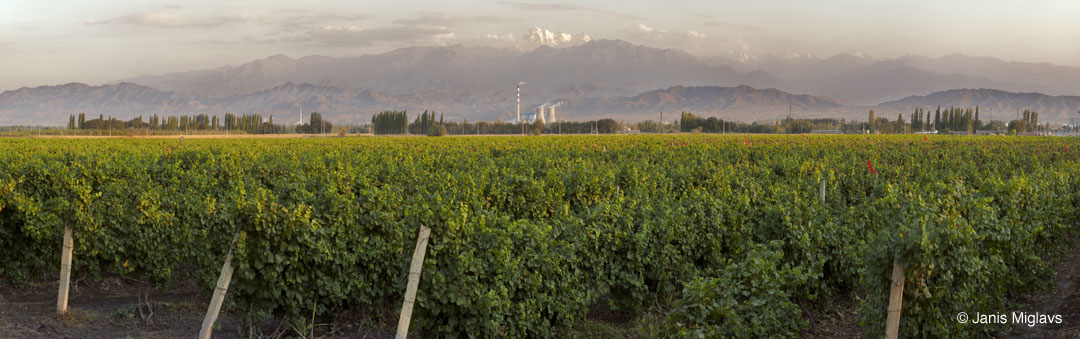
This photograph sums up the Xinjiang Province for me: grapes, nuclear power, lots of construction and incredible landscape.

Premium Cabernet Sauvignon vineyard where Citic Guoan Winery (known as Citic Guoan Wine Sales Co., LTD and formerly Suntime International Wine Company) gets grapes, with a nuclear power plant and Bogda Peak in the Tian Shan Mountain range, Fukang, Xinjian Province, China, Asia
.

Friday, April 13, 2012

Why is Bigger Better in China?


In 1985, Hong Kong-based British wine merchant Michael Parry started building Chateau Huadong Parry just outside of Qingdao, Shandong Province, China. Today, general manager Liu Hong Mei says that the chateau is too small by Chinese standards. She says Bigger is Better in China.

Wait until you read
in the Chinese Winery book I'm writing about how Parry mistakenly named his winery.

Why is bigger better in China?
What do you think about winery size?

Tuesday, November 22, 2011

Is my baggage preventing me from accepting Chinese Culture??

Is it true as one travel writer espoused: "Traveling, one accepts everything; indignation stays at home?"

This is Ganden Sumtseling Monastery, the largest Tibetan Buddhist monastery in China's Yunnan province and sometimes referred to as the Little Potala Palace. Built in 1679, it is blessed and cursed by being only 5 kilometres (3.1 mi) from the tourist city of Shangrila. So Chinese tourists flock to this spiritual site. Check out the wad of visitors climbing the stairs in the right background.

Among the swirling, camera-toting tourists, hundreds of monks try to conduct their lives and spiritual rituals.

Truthfully, I had trouble suppressing an uneasy indignation. Perhaps I'm bringing my own cultural baggage. Yes, tourism financially supports the monastery. But to me the balance between spirituality and tourism was like oil and water.
For some, the monastery was simply a Hollywood prop.

This lady focused her Canon camera on her shoes.

Is my baggage preventing me from accepting the reality of Chinese Culture?

Wednesday, November 9, 2011

Is this like a Chinese Vineyard in Yosemite?

I couldn't help but post one of the images from this series.
This steeply sloping farmer's vineyard near Yunling (Yunlingxiang) above the Lancang (also called Lantsang, Lansang and Mekong) River, is one of hundreds in northwest Yunnan Province, China. All of these vineyards, hacked out of these steep mountain sides in this region, supply Cabernet Sauvignon and Merlot grapes to Shangri-la winery. Single handedly, the Kunming-based "wine brewery" has changed the economy of this high-mountain region bordering Tibet.

When the hour isn't so late, remind me to talk about the wine. Surprising.

Do We All Need to be Strangers?

Part of the joy of travel for me is the chance encounters with billionaires, vineyard workers, CEOs and winemakers. We're all just people, nothing more, nothing less.This guy He was laughing at my attempt at Chinese during harvest at a Huadong Parry winery vineyard near Qingdao (sometimes spelled Tsingtao, a coastal town famous for its beer), Shandong province. Truthfully, he did have cause for laughter.

I'm always amazed at how generous people can be. Here I am snapping with a camera costing perhaps 10 years of this woman's wages and she is offering me grapes. Just the thought makes me hopeful about we little humans.

This photograph was taken just after he hauled up two crates with 66 pounds of harvested Cabernet Sauvignon grapes up a steep mountain. This is in the Gushui Village vineyard above the Lantsang River, Yunnan Province for ShangriLa Winery.
Check out his outfit. This after he had been picking and hauling for half a day. Never did I look this debonair when I picked grapes in Napa. Also look at the ethnic diversity in Yunnan and Xinjiang provinces.


This is winemaker Emma Gao. One day her father, who managed vineyards, thought that they should make their own high-quality wine-something rare in China. He called Emma, who was studying in Russia, to ask if she wanted to make wine. "Yes, Papa." She then went to France, learned French in 4 months and studied winemaking there for four years. Back in China, Emma, with the micro family winery, Silver Heights, has earned a well-respected reputation for their wine. I even hauled a bottle back to the United States to share.

Oh, yes,
her husband, Thierry Courtade, the winemaker at Chateau Calon Segur, and five-year-old daughter, also called Emma, both live in France.

And those towering new apartments in the background are the city of Yinchuan, Ningxia province, englufing the tiny family winery like a tsunami wave.


I like my job.

Saturday, November 5, 2011

Airline cuisine on Chinese Domestic Flights

So I ended up taking 8 Domestic Flights in one month during this last trip to China, all on Chinese airlines. On most of the flights we received a small bottle of water. Here's the fare on a 3 and 5 hour flight.

* As a footnote, all of the airplanes seemed very new. But I kept wondering how safe the domestic flights will be in 10 years as the aging planes demand more maintenance?

Friday, November 4, 2011

Beijings Famous Tax Waiting Area

Can you guess what this sign just out of the baggage area at Beijing's airport is suppose to say?
But then I can't read most of the Chinese characters.

Wednesday, November 2, 2011

I didn't deduct China from my time on earth.

Somewhere I read that the best travel seems to exist outside of time.
This last China Wine trip was like that. It's as if the month of travel was not deducted from my time on earth.
(Above) Way out in the remote western Xinjiang province, this is the Cossack ethnic neighborhood of Wulumuqi (Urumqi), the Province's capitol city. The whole town had the non-sleep energy of Las Vegas, but times 10. Time, however, can throw a tired traveler. Since the central government declares that all of China is to be on the same Beijing time, and Xinjiang is about 4 time zones to the West, dinner and night life don't begin here until about 10:00PM (Beijing time). Like Vegas, a peek at Google Earth reveals that the town sits like an oasis surrounded by huge sand dunes.

(Below) Out on the main street of Fukang, Xinjiang, we chose our food from the table and watched the husband and wife chefs cook it. Never heard of Fukang? Well, a 1003 kg meteorite crashed near here in 2000, it's a booming oil town sitting near what is reported to be more black gold reserves than the entire United States. And, for me, a branch of Citic Winery (formerly Suntime) has a massive wine factory and huge vineyards–like green islands in the sandy desert–on the outskirts of town.

Monday, October 31, 2011

In Search of Undiscovered Wine

In the course of my wondering life, travel has changed. During my first trip to Africa, there was not even satellite phone coverage over the remote areas I visited. For 5 weeks my wife had no idea of my whereabouts or even if I was still alive. But for me, it was the Columbus-like thrill of discovery.

Today much of the world is connected and known. Just Google it. Now I regularly email the chief of the Bediks, a tiny cliff-top Senegalese tribe virtually unknown when I first visited.

So where's the thrill, the adventure of travel today? And for me, where's the excitement of stumbling upon an undiscovered wine, a wine that even Google can't find?

I found it in China.

During September and October I explored all of China's major wine growing regions, (I'm told I'm one of the few if not only Westerner to do so). It was a Columbus-like trip of discovery about terroir, people, culture and myself. It was a travel adventure.
The photo of Beng (Bu) village with it's vineyards hints at the terroir in Yunnan Province near the Tibetan border. At 2000 to 3000 meters (6000-9000 feet), the vineyards in this area are probably the highest in the world. The growing season is Continental-like sunny (3000-3500 heat units); the well-drained soil is gravel, sand, loam and little clay (the whole area was once a lake bottom); and virtually no rain during growing time. Days are warm, nights sweater cool. And the only winery to use all the fruit is Shangrila.

Please note that the lines scribbled across the landscape are both one-car-width gravel roads and human trails.

Wait till I tell you about the wine.


Saturday, October 15, 2011

China and Wine in One Photo?

After a month of visiting all of China's major wine growing regions, this single photo sums up my findings.

The
premium Cabernet Sauvignon vineyard in the photo foreground is in the wild wild west province of Xinjian, China's most remote region. Sitting way out in the far west bordering Mongolia and a list of stans including Kazakhstan, Kyrgyzstan, Tajikistan and Pakistan, most of the province is wide open Taklimakan Desert where the most dangerous portion of the Silk Road winds through the world's largest shifting dunes moon-like landscape. Remote. The capital of the province is the world's furthest city from any ocean.

But, because of the warm summers and well-drained soil, it's a great grape growing region. This vineyard belongs to Citic Guoan Winery (formerly Suntime), which also owns Asia's–if not the world's–largest vineyard spreading out on Xinjian's sandy soil. The area is booming. A couple hundred kilometers from this vineyard near Fukang, sits an oil reserve that is suppose to be larger than anything in the United States. Dozens of Nuclear power plants dot the region like acne on a teenager. Yet in the distance tower incredible snow-capped mountains.

This is the China I experienced in September and October. Things are booming, including the wine industry. More adventures and observations to come.

Wednesday, August 18, 2010

Searching for Chinese wineries along the ancient Silk Road.

For my upcoming China winery trip–Sept 17 - Oct 13–it's high mountains, dry deserts, the Silk Road and ancient scrolls about wine. So here are my current winery choices rationally arranged by province. Follow along on the map but remember that China is disputably about the same size as the USA. Any suggestions or insights gladly accepted.

Shanxi province. On the thoughtfully provided map look for a vertical fat-pinply-hot-dog shaped yellow area at the top center-right of China hanging like an udder below Inner Mongolia.
The dusty Terra Cotta Warriors march here and the ancient Yellow River Bed meanders through
.
Here I already visited one of China's most highly regarded wineries in terms of drinkable wines, Grace vineyard.
On this trip it's Jade Valley winery for it's scenic location and famous architect owner. Perfect photo combo.


Ningxia province. On the map look at the left side of the big green Inner Mongolia Autonomous Region, located at the top of China. The Yellow River and the Great Wall of China flow through the province. While it's sparsely populated, probably because it's mostly desert, the vast plain of the Yellow River in the north has been irrigated for centuries through an extensive system of canals. Wine production flourishes in the eastern part of the Helan Mountains Region, so that's where I'm going. Jancis Robinson–a famous wine writer–says that Ningxia seems to be a seriously up and coming region for vineyard investment. So we will find out if lots of money guarantees great, even good wine.
Targeted wineries include Helan Mountain, operated by Pernod Ricard–my how those French get around, Dragon's Hollow, which surprisingly produces mostly for export and Silver Heights, where Emma Gao is winemaker.

Xinjiang Province That big orange amoeba-shaped area on China's far left side, is Xinjiang, which literally means "New Frontier." It's home to the restless Muslims you might have read about in the news. It's also home to the largest vineyard in all of Asia. Lots of ancient history here, incl With the Silk Road trekking right through the area, there's lots of ancient history, including mention of wine in the BC time. This province, containing the Gobi, is renowned for its grapes and, no sunny surprise, raisins.
Summers tend to be hot and dry, so the grapes have higher sugar content and fewer problems with disease than in coastal regions, though they sometimes lack acidity. Winters are extremely cold and the vines need extra protection to survive by being buried with dirt, which then blows away later.
Wineries under scrutiny– Loulan and Suntime–are located way to the center left of the oversized province.

Inner Mongolia Autonomous Province Crowning China on the map, the big green squished water balloon-shaped area is Inner Mongolia Autonomous Region. (Why certain provinces are called Autonomous is a topic for another blog.) While there are some wineries in this sand-dunned area already, some growing adapted vines that can withstand the -35 degrees C (-31F), I've heard about a mega project near Bayan Nur City to create a vineyard in the Ulan Buh Desert. According to the municipal desert control authority–how would you like to be in charge of shifting sand dunes, the project will cover a total area of 26,667 hectares (65 895 acres), yield 600,000 tonnes of wine grapes a year. Will that help quench China's thirst?

Yunnan Province Finally, the orange squished amoeba looking province is Yunnan. Here one winery is suppose to be at 3000 m (9000 ft) elevation.
Here I'm looking at Shangri-la Winery and Sunspirit, where one winery building is Tibetian style. More about this later.

Wednesday, February 10, 2010

Farmers can't see Wangfujing Shopping Street

This photograph will be framed and given to Oregon State Representative Matt Wingard to commemorate his recent trip to the land of contrasts, China, including Tianjin city.


Chinese farm workers get to the fields and vineyards near Tianjin as they have for hundreds of years while more affluent urbanites take digital point and shoot photos in front of upscale shops on Wangfujing Shopping Street in Beijing.

Wednesday, January 13, 2010

Google is more of a man than I

When I first heard the news, I twinged of guilt.

More than likely you heard that today Google threatened to pull out of China. Apparently someone in China compromised Google's system and targeted malware attacks on some gmail account holders–who just happened to be activists against the Chinese government. Obviously the main suspect, the Chinese government's heavy hand.

As the story unfolded, it brought memories of my own internet adventures in China.

For me, Beijing was no problem internet wise. I wasn't Googling or Baiduing (verbasizeation of the Chinese version of Google) "Tibet" or "free speech" and the country's anniversary celebration was still
several weeks away. But at Grace Winery in Shanxi Province, I went to make my nightly call to my wife through Skype. Surprise. On the screen appeared the dreaded "you have been redirected" to no where message. I tired again. And again. Apparently The Government doesn't always care for the freedom Skype offers.

But heck, I just wanted to talk with my wife. Now I'm not a computer wiz. So it took me several hours to figure out how to get around the block. Too late to talk with my wife that night; so I looked at dozens of blogs reporting the same blocked Skype problem I had.

Late that night, the horns of dilemma gored me.

I started to post how I circumnavigated the Skype block. Then a bucket full of cold reality splashed me. Here I was in China trying to establish relationships with wineries. And these wineries were either totally or mostly owned by the Chinese government. Obviously, they could read everything I posted.

I caved. I didn't post. I could have helped lots of people. But I kept justifying, "if I posted, the government would know the trick and me."

Now a couple of months later, hearing the Google news I feel twinges of guilt. Google didn't cave. With its actions today, Google is more of a man than I.


Part of a sculpture in the Forbidden City, Bejing, China.

Thursday, December 3, 2009

China Wine: From Cow to Castle

Do you have the same a visual disconnect I have between the photos of farmers plowing in the vineyard with a cow and the huge castle-like chateaus the wineries build?
These farmers are working in a vineyard which provides fruit to Dynasty Winery near Tianjin.


Then check out the new Chateau Dynasty is building (below right). The panorama is Chateau Junding in Shandong Province. I didn't see any cows pulling equipment here.

Tuesday, December 1, 2009

China Wine-Striving for Big

What is it in the Chinese Wine psychology that attracts BIG?


This is Dynasty Winery's new facility near Tianjin, just next door to their current winery, tasting room and offices. (By the way, what architectural influences do you see here?)

Here are the figures and facts for Dynasty: Established in 1980, as a Sino-French Joint-Venture, the second ever Chinese-foreign joint venture in China, created between the Chinese government, the French brandy producer, Remy-Martin, and Hong Kong International Trade and Technology Investigation Organization–whatever that is.

So get these production numbers. In 1980–first year for Dynasty–they produced 100,000 bottles of wine. First year. Remember that many, if not most Oregon wine producers in my backyard, output maybe 60,000 bottles, after years of being in business. By 2002, Dynasty's total production of wines and brandies reached 35 million bottles. That's more than two times what the entire state of Oregon produces.

And that's only one winery in China. Big or what?


Sunday, November 1, 2009

Does China have Wineries or What

"I didn't know that the Chinese had wineries," is the usual response I get when I tell friends that I'm doing a book on Chinese Vineyards & Wineries.

Well, they do. In fact, the Chinese have more vineyard acreage than the United States and South Africa combined. And the Chinese produce more wine than Germany.

Check out some of the wineries I've visited.


Yes, the Chinese do wineries, big wineries.